“I was engaged from the get-go by Bronwasser’s Listen, a riveting exploration of how random crime can have lasting effects on people. Ably translated from the Dutch by David Colmer, the novel explores what it is to be young in a city not your own, free to adhere to whatever capricious whim you might want—only to be upended by circumstances far beyond your control.”
—Sarah Weinman, The New York Times Book Review
“Listen is a meticulously constructed yet unnervingly quiet thriller that stays under readers’ skin from start to finish. [A] unique, twisty meditation on terrorism, art and the influence of various media on our lives. It’s so compellingly well-crafted that it invites rereading to fully appreciate certain lines—and its devastating title—once all is revealed.”
—BookPage (starred review)
“Bronwasser makes the banal exceptional with an eye that not only looks but sees.”
—Kirkus (starred review)
“Cannily constructed and gracefully written, this thought-provoking literary thriller offers a charcuterie board’s worth of rewards.”
—Publishers Weekly (starred review)
“This psychological puzzler will keep readers engaged from start to finish.”
—Library Journal
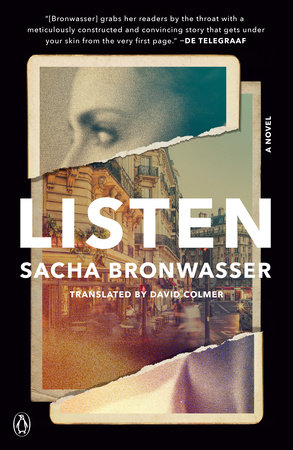
“[Bronwasser] grabs her readers by the throat with a meticulously constructed and convincing story that gets under your skin from the very first page.”
—De Telegraaf
“Sacha Bronwasser describes Parisian life irresistibly, in a thought-provoking novel. It’s a rare thing, a book that can be read as simply a ‘good read’ but with enough in it to make you think.”
—de Volkskrant
“A highly ingenious novel that is also moving . . . Listen is somewhat reminiscent of W.F. Hermans and Peter Terrin, with its sense of a stalkerish, indefinable foreboding, while the story is nevertheless resolute and evocative, and told in a way that definitely rewards the reader.”
—NRC
“Ingenious new novel . . . Masterfully constructed . . . A novel that you can only admire.”
—Trouw
“Once you understand the full, wry relevance of the title on the very last pages, only then do you fully realise how masterfully constructed this compelling book is. The skilfully written, suspenseful story turns out to be an intelligent and ambiguous reflection on remembering and recording, on seeing and being seen, on coincidence and makeability, and on the ethics of art and of the appropriation of other people’s stories. The question that continues to haunt you at the end is to what extent the novel is an act of revenge and, as such, an example of the unethical appropriation it denounces. Good, clever, deep. Without question premier league, this novel.”
—Ilja Leonard Pfeijffer, author of Grand Hotel Europa







 QUICK VIEW