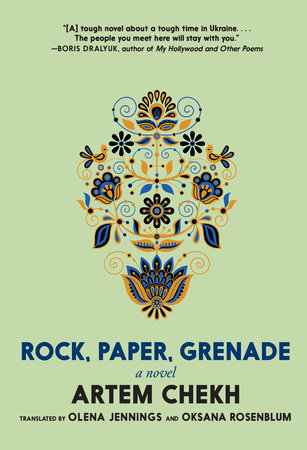
“Rock, Paper, Grenade is not a novel that attempts to be idealistic or cynical about father-son relationship. Instead of depicting Felix as entirely villainous, Chekh opts to sketch him as is a tragic figure, simultaneously threatening and utterly removed. In this, homophobia and even traditional masculinity are seen as forces of intense social isolation, turning familial relationships into battlegrounds. At a time when anti-queerness in the US has reached frightening extremes, and as war exacerbates some of the cruelest and most brutal aspects of gendered existence, a translation of this novel has never been more crucial, reminding its readers of the way that hegemonic gender can reduce everything to a fear-based performance.” —mk zariel, Asymptote
“’He’s like a guide… to the kingdom of the dead,’ someone says, early on, of one of Rock, Paper, Grenade‘s many unforgettable characters. And Rock, Paper, Grenade is, in its own inimitable way, also a kind of guide—not to the kingdom of the dead, but to the blazing anti-kingdom of the living: not the story of kings, despots or heroes, but the story of soldiers and drunks, neighbors and grandmothers, starving dogs and beloved poisoned cats, in all their mortal vulnerability and complexity. A tender, sharply-imagined coming-of-age novel, full of clarity and bleak humor: a book as shrewd about historical damage as it is about personal repair; as piercing about post-Soviet loneliness as it is about our most ancient pull to salvage and connect. A funny, haunting and beautiful book.” —Elaine Castillo, author of America Is Not the Heart and forthcoming novel Moderation (summer 2025)
“Artem Chekh’s Rock, Paper, Grenade is a tough novel about a tough time in Ukraine, yet the author’s tense, electric prose—rendered with icy clarity by Olena Jennings and Oksana Rosenblum—communicates more than the harshness of the first post-Soviet decades. Chekh understands the lives shaped and misshaped by that era, cares about them, and we find ourselves caring as well. The people you meet here will stay with you.”—Boris Dralyuk, translator and author of My Hollywood and Other Poems
“War trauma, once it has taken root inside a person’s (or a society’s) soul, can never be expunged entirely. This is a vital book for anyone wishing to understand Ukraine, but its insights are relevant wherever the violence of the past intertwines with hopes for the future.”—Uilleam Blacker, Associate Professor in Ukrainian and East European Culture, University College London
“Few novels render the tension and uncertainty of the post-Soviet era so vividly, while still finding room for unexpected warmth.” —Kate Tsurkan, The Kyiv Independent






 QUICK VIEW