



READERS GUIDE
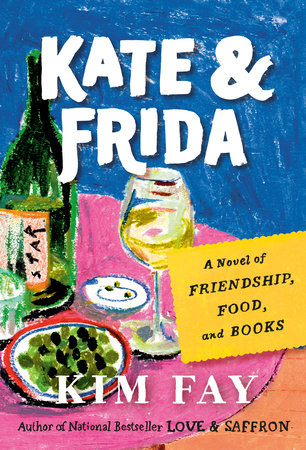
A Conversation with Kim Fay1. What do you think was so special about Kate and Frida’s immediate bond that made them want to continue writing letters to one another?
Frida recognized her insecurities in Kate, even though she would never admit it, and Kate saw her desire to be more courageous manifested in Frida. They not only saw themselves in new ways through each other from the very start, they felt the particular tremor of possibility that only occurs in the first stages of certain relationships.
2. Kate and Frida’s connection continues to grow through their correspondence. Does their relationship remind you of any of your own close friendships?
Setting aside the letters, I think there are certain friendships based on a magical initial bond that can only grow stronger over time. I met Beth Branco (Stella) more than thirty years ago when we worked at the Elliott Bay Book Company. We shared a magnetic curiosity about our differences, and our early intense “courtship” phase set the stage for continual growth. Although we’ve spent hundreds of hours talking over the past three decades, on our most recent getaway to Joshua Tree, conversations under the desert stars were still able to reveal nourishing new aspects of our friendship.
3. What was your favorite part of revisiting the ’90s through the lens of Kate and Frida?
Since Kate and Frida are made up of parts of me, I think I was revisiting that time through my own lens. I loved being able to exist before the internet. Back when my brain wasn’t fragmented by social media and needing a different password for virtually everything I do. And to be in Seattle during that era! The sophisticated midcentury Central Library still stood—thankfully the new one kept the original twenty-seven-foot-long Northwest Screen and George Tsutakawa’s Fountain of Wisdom, although the vibe will never be the same for me. It was a time when hipster dive bars were just called neighborhood bars, and the Lusty Lady’s marquee made downtown laugh with its sexy current-event puns. Seattle was an amazing blue-collar city for everyone, and I relished residing in that space once again.
4. Kate edits herself a lot in her letters, usually because she’s looking for the right words. What do you think this says about her?
Beyond Kate being insecure in her intelligence, she’s trying to figure out who she is. How she expresses herself is a way of defining herself. As she lets go of words from her past and tries new language and ways of formulating thoughts, she is seeking to shape her identity and become the person she should be. Or rather, the person she thinks she should be—just as I thought I should be at that age, as is evidenced in a novel I wrote during that time. Never have so many words been experimented with and misused so enthusiastically in a single manuscript!
5. During what is described as the “century of wars,” what inspired you to send Frida to Sarajevo over other war-torn locations at the time?
When I was working as an indie bookseller in the early 1990s, three events woke me up and caused me to grow up as a citizen of the world: the Gulf War, the Siege of Sarajevo, and the Rwandan genocide. I wasn’t sure where Frida would go when I started the novel, but during my research, when I discovered the targeted burning of the library in Sarajevo, the decision was made for me. That atrocity underscored themes about community and loss that I was exploring, and as I wrote, Sarajevo flowed naturally into the story.
6. What went into deciding which books Kate and Frida would share with one another?
Simply, they read what I was reading in my early twenties. Every book that Kate and Frida corresponded about was a significant part of my growth. While there were other authors and other important books from that time in my life, and I wish I could have included them, too, I had to let the story guide the choices. It was hard, because it was like inviting some of my children to a party and telling the rest that there wasn’t enough room for them to attend. I hope they will forgive me.
7. What was your favorite scene/letter to write, and why?
There are two. The first is when Kate stays with Bumpa and watches him tinker with a radio in the middle of the night. The second is after Bumpa dies, when Kate sits with her mom, also in the middle of the night. In both scenes, her relationships with them deepen, and they are precious to me because they are amalgams of moments I shared with my Bumpa and my mom. To be able to put those priceless moments on a page—put them out in the world—is an honor.
8. Throughout the novel, food is shown to be such an important symbol for human connection, such as the bosanski lonac Frida makes for the Ramona Club. Are there any of your own personal experiences with food that went into writing about this idea?
As I wrote about food in Kate & Frida, I thought often about the four years I lived in Vietnam. So many of my relationships there flourished while sharing a table and forging culinary rituals—yes, my dear friend Hường, I’m thinking about our weekly lunches of miến gà behind Bến Thành Market! This led to my writing a food memoir, Communion: A Culinary Journey Through Vietnam, which is an exploration of the relationship between cuisine and culture. It examines how flavors, when taken away, can have a profound effect on a person’s sense of identity, and how the simplest of meals can give total strangers common ground.
9. What do you hope readers learn about the nature of friendship from reading Kate & Frida?
I want readers to be reminded that a good friendship should never be a chore. It should be a safe and uplifting place for exploration and growth. I’m not saying it’s not hard at times. Or that it should always be ponies and roses. But real friendship—a friendship built on trust and laughter and vulnerability and love—is complex, gorgeous, and laced with magic. We’re not made to be friends with everyone, but when we find a friend we are made for, it is one of life’s most precious experiences.
10. Without giving anything away, did you always know how the story would end?
What occurs in Kate’s last letter was clear to me from the moment I wrote Frida’s first letter. I never start a novel where I don’t have a pretty solid idea of the ending. It gives me something to write toward and helps me stay on track.
11. What’s next for you?
I’m working on the third book in this trilogy. Frida and Kate are now in their fifties, and Frida’s mom, Joan, from Love & Saffron, is in her eighties. The former reflect on the satisfactions and surprising new challenges of midlife, while the latter looks back and considers what defines a life well-lived. Despite a setting in the present day, I have found a way for this to be an epistolary novel, and I’ve also found a way, without resorting to ghosts, to bring in Love & Saffron’s Immy. It’s such a pleasure to spend time with these beloved characters again.
Discussion Questions
1. Do you think you relate more to Kate or to Frida?
2. There are so many delicious recipes and dishes mentioned throughout this book. Which of them would you be the most enticed to try, and why?
3. Kate and Frida’s friendship is established out of their love of books and “the power of words.” What does this idea mean to you? Do you agree with them that literature, and the written word, are more timeless than other mediums?
4. Have you ever felt anxieties, like “bees buzzing,” as Kate describes? If so, how did you combat those feelings?
5. Kate and Frida each discuss many people in their personal lives within their letters. Who was your favorite of those characters, and why?
6. Kate and Bumpa have such a special connection, shown through a wide variety of her letters to Frida. Is there anyone in your own life that you share this type of intimate, loving bond with?
7. Frida’s venture to Sarajevo doesn’t pan out the way she’d imagined the start of her war journalism career would. Have you ever had your expectations thwarted by reality? How did you handle it?
8. What was your favorite moment in the novel, and why?
9. Throughout the novel, Kate and Frida teach each other many life lessons. What is the most important thing you think you learned from them?
10. How did you feel about the way the novel ended?