READERS GUIDE
Introduction
In this moving debut work of nonfiction,
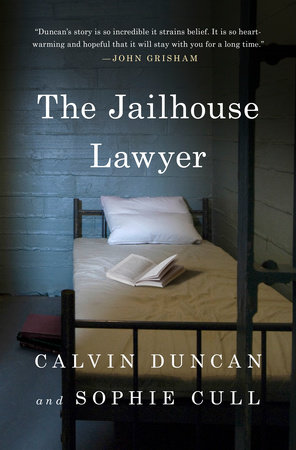
The Jailhouse Lawyer gives readers an unflinching inside look at the carceral system and the broader landscape of American criminal law through the eyes of Calvin Duncan, whose own incredible story of learning and practicing the law while incarcerated takes readers on a journey they will not soon forget.
In 1982, Calvin Duncan was arrested while at a job corps camp in Oregon for a murder in New Orleans that he did not commit. He was nineteen years old. Over the course of almost three decades following the arrest, most of that time spent incarcerated in Louisiana’s notorious Angola prison camp, Calvin earned a job as an inmate counsel and eventually taught a law class at the prison, working on thousands of his peers’ cases while also determinedly exhausting every legal option available to him in his own case.
By turns both an education in the countless ways that humanity, decency, and basic legal rights are ignored or forcibly taken from the men of Angola and a heartbreaking story of how one man held on
to hope and purpose in the midst of decades of setbacks and closed doors,
The Jailhouse Lawyer is a powerful testament to the difference one person can make, even in the face of impossible odds.
Questions and Topics for General Discussion 1. Calvin begins his prologue by quoting a line from Charles Dickens’
David Copperfield that he used often during his time teaching law at Angola: “‘Whether I shall turn out to be the hero of my own life, or whether that station will be held by anybody else, these pages must show.’” (p. 1) Why do you think these words are so important to Calvin?
2. In what ways are Calvin’s story and the stories of those incarcerated along with him affected by the 1980s and 1990s “War on Crime” era?
3. What unique challenges and opportunities did Calvin and his friends encounter as they tried to help each other in the midst of their confinement?
4. Calvin chooses, early in his incarceration, “…to make the law the site for his battles, where winning would build character rather than destroy it.” (p. 60) What are the ramifications of that choice, for himself and for those around him?
5. What role does Calvin’s family play in his life, both in his early childhood and then during his time in Angola?
6. How does Calvin’s early legal work with residents of Angola’s mental health unit shape the rest of his time as an inmate counsel?
7. Discuss the roles played by Judge Frank Shea and Judge Julian Parker in Calvin’s story. How do their personal dispositions and preferences affect the legal processes surrounding Calvin’s trial and appeals for post-conviction relief?
8. How did figures like Mrs. Rabalais, Emily Bolton, Alvin, Emily Maw, and others offer needed support to Calvin at key moments during his incarceration?
9. What about Calvin’s journey through the legal system most surprised you? Angered you?
10. One of the first things Calvin teaches the students in his law class is to know their cases inside and out. “‘Your case is your life,’” he says. “‘Don’t ever let it rest in someone else’s hands.’” (p. 204) Why is this Calvin’s first lesson? And how does this lesson play out in Calvin’s own case?
11. As Calvin’s legal journey concludes with a guilty plea to time served (“It was the only time he would ever lie under oath” (p. 342)), what thoughts do you have about truth? What truth(s) mattered for Calvin’s case in the end? How did his character and behavior while incarcerated become an important truth apart from the facts of his case?
12. Calvin’s coauthor, Sophie Cull, writes, “The more I learned through our interviews, the more I saw that Calvin being wrongfully convicted—grotesque and unimaginable as it was—was in some ways the most ordinary aspect of his experience.” (p. 350) What light does this shed on the United State’ carceral system, and on the lack of justice for Black men in Louisiana and New Orleans in particular?
13. Reflect on the significance of Mount Hood for Calvin throughout his story, and his words when he visits with Sophie after he is released: “Now, I am really free.” (p. 361)
Questions and Topics for Those Working in the Criminal Justice Space 1. Discuss the quote from Calvin’s friend Joe Washington: “There’s no such thing as constitutional rights. There’s just a pendulum that swings backwards and forwards” (p. 64), especially in light of waning public confidence in the US Supreme Court.
2. How specifically did Chief Justice William Rehnquist’s support for states’ rights affect the criminal appeals process?
3. In all of the denied appeals and moments on which Calvin’s case turned and his freedom hung in the balance, is there one instance that you found particularly harrowing?
4. Discuss the interactions between the 1996 Antiterrorism and Effective Death Penalty Act (AEDPA), the drive to accelerate appeals and executions in capital cases, and the effects on state court review of habeas corpus applications in noncapital cases like Calvin’s.
5. Thinking about Calvin’s case specifically, discuss the ways the law fixates on process rather than substance. What are the reasons for this focus, and what are its implications?
6. As you reflect on the conclusion of Calvin’s case and the many stories of his fellow incarcerated men, what do you think are the most needed reforms to bring justice to them?
Further Reading Books
The Brethren: Inside the Supreme Court, Bob Woodward and Scott Armstrong
Caste: The Origins of Our Discontents, Isabel Wilkerson
Charged: The New Movement to Transform American Prosecution and End Mass Incarceration, Emily Bazelon
Dead Man Walking: An Eyewitness Account of the Death Penalty in the United States, Helen Prejean
God of the Rodeo: The Quest for Redemption in Louisiana’s Angola Prison, Daniel Bergner
In the Place of Justice: A Story of Punishment and Deliverance, Wilbert Rideau
Just Mercy: A Story of Justice and Redemption, Bryan Stevenson
The New Jim Crow: Mass Incarceration in the Age of Colorblindness, Michelle Alexander
Solitary: Unbroken by Four Decades in Solitary Confinement: My Story of Transformation and Hope, Albert Woodfox
Film
13th (documentary), Ava DuVernay
Calvin’s Notable Books in
The Jailhouse Lawyer The Cider House Rules, John Irving
The Count of Monte Cristo, Alexandre Dumas
Man’s Search for Meaning, Viktor Frankl
Great Expectations, Charles Dickens
Profiles in Courage, John F. Kennedy
To Kill a Mockingbird, Harper Lee
Roots, Alex Haley