



READERS GUIDE
Questions and Topics for Discussion
- Gershom’s story in this novel is a kind of fictional biography, but the character’s life deviates quite a bit from historical fact. Why use Dr. Scholem as a character? Why not further fictionalize him and present him under a different name? How does his quasi-historicity affect your reading?
- Meanwhile, Menke does not share a name with any real historical figure. What do you make of his and Gershom’s apparently uneven statuses with respect to historical fact? Do you approach these characters differently as a result?
- Doubles, mirrors, shadows, and halves are a prevalent motif in this novel; even the novel’s structure involves doubling in more than one sense. Where do you notice this motif? What is its significance?
- How does Gershom view Eastern European Jews? What role does his image of them play in his concept of a unifying Jewish identity, and what is the nature of this image? On what is it based?
- Images of theatrical performance make up another major motif here—what is their significance? What is the relationship between performance, belief, and truth in this novel?
- How does Gershom’s delivery of the “oy, am I thirsty” joke differ from Menke’s, and what does this tell us about their characters? Is Gershom still, by the end, “not a very funny guy”?
- Do you think the decision to smuggle the books is ethical? Does Gershom’s claim that “the distinction between books and people was finally moot, since each depended on the other for their ultimate redemption” (131) ring true to you?
- Nachum the book peddler and Tsippe-Itsl live on the margins of the already marginal shtetl; both are perceived as potentially inhuman by the shtetl community due to their physical differences. Does the narrative also cast them as not quite human?
- How is appetite significant in this novel?
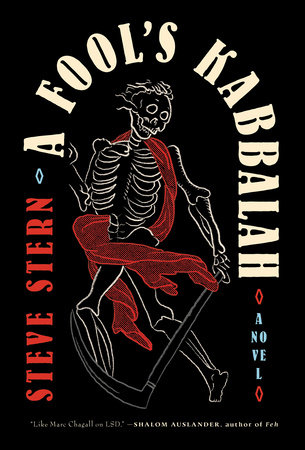
- What is the aim of Gershom’s “fool’s errand” (224), and does he conclusively accomplish it? How is the book he carries important? What is the narrative purpose of this episode?
- Is Menke’s return to joking at the end merely a reversion to form, or does it underscore a deeper change in his character?
- The fool who evades fate and bests the powerful with a joke is a figure in many folkloric traditions. How does Menke’s character respond to this stock figure? What’s the novel’s verdict, if any, on the fool’s capacity for parrhesia (speaking truth to power), and on parrhesia’s potency against evil?