




READERS GUIDE
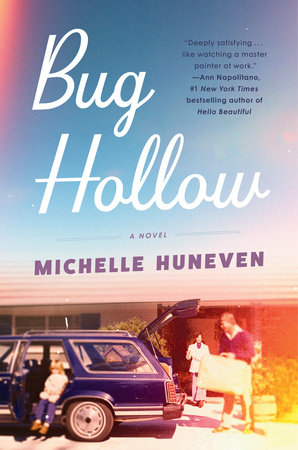
About this GuideThe questions, discussion topics, and other material that follow are intended to enhance your group’s conversation of Michelle Huneven’s Bug Hollow, a sweeping, multigenerational novel with a heart as big as the Samuelsons’ many-limbed family tree—wherein the conventional plots of marriage, parenthood, love, and happy endings are constantly challenged by death, betrayal, and secrecy, and rewritten as proof of the endlessly creative and resilient human spirit. Balancing wit and whimsy, Bug Hollow is a story that reminds us of the beauty that can arise from even the biggest mistakes, and how freedom can be found in the unlikeliest of places—like a dilapidated old hunting lodge in the Santa Cruz mountains.
Questions and Topics for Discussion
1. Ellis is a consistent presence in the book, but his influence is most deeply felt when he’s not physically present: when he first leaves for the summer in Bug Hollow, and then after he dies. How do we get to know Ellis even in his absence? How do his family’s memories keep him alive in the story? Is there someone in your life whose persona looms large even when they’re not physically present?
2. What makes Bug Hollow seem like a threat—even cultish—to the Samuelsons when they hear about it from Ellis’s letters? Consider how the things that alarm them—the changes in his diet and happiness, his new use of the word “love”—are often sought-after in modern times.
3. The novel takes place over many decades of American culture. What historical or social moments stood out to you as most significantly affecting the characters’ lives? Did you live through any of these time periods yourself, and could you connect to the social expectations described? If not, how does this family’s story compare to other stories you’ve encountered that were set during this period?
4. Sib acts like a different person when she is at school as a teacher, compared to when she is at home as a mother and wife; when she thinks of her daughters, “Sib loves them, she does, too much, and yet alone with either one, she wants to hide behind a stone wall” (p. 63). Why do you think she’s able to offer more care and compassion to her students, especially to the mute boy Sandro? How do her children respond to her distance, both as they’re growing up and once they’ve left the house?
5. Why does Sib push Sandro to speak in school? Consider his mother’s response to Sib’s concerns about his academic prospects if he were to stay mute: “School is not the most important thing in his life. We are. His family. [….] He will figure things out” (60). What do we learn about how Sib’s tenacity affected Sandro’s life? Do you think she did the right thing as a teacher?
6. Do you think Sib’s judgmental attitude and drinking are responses only to Ellis’s death? What coping mechanisms or changes have you experienced or witnessed in others after major life events, positive or negative?
7. As with Sib, does Phil’s character fundamentally change when he’s abroad in Saudi Arabia? Or is he consistent?
8. What attracts Yvette and Phil to each other? Compare their relationships with their spouses and how the circumstances of their meeting lead to romance.
9. Compare Sib’s and Phil’s reactions to Ellis’s death. Does Eva’s presence soften the intensity of their trauma, as they continue to parent Ellis in a way via his daughter? How might their relationship with their daughters (and Eva) have been different if Ellis hadn’t died?
10. When Julia and her mom go to Italy, she spends time observing a painting of the Virgin Mary and relates to Mary’s expression of frustration at being “interrupted” by motherhood (p. 47). During the trip, she also tells her mom, “I had forgotten fun” (p. 50). How does motherhood both interrupt and enrich Julia’s life? What does she gain by being attached to Ellis’s family?
11. Were you surprised to learn about Sib’s breast cancer diagnosis and how she handled it? Discuss the family’s cooperation with her end-of-life requests and how each of them confronts the loss of the family matriarch.
12. Do you think Katie felt satisfaction or closure with how she spent her last days
with Sib? Have you ever tried to mend a relationship at a critical moment like someone’s deathbed—and did it go as expected?
13. Eva worries that when she goes to college, she’ll initiate the same fate as her father and might get hurt or die—but thankfully, this doesn’t come true. Where else in the novel do patterns of behavior repeat themselves among generations of families? Did these patterns seem fated to you, or are they a matter of personal choice and circumstance?
14. When the girls return to Bug Hollow to scatter Ellis’s ashes, they find the original house transformed into a bed-and-breakfast/spa. How was this unexpected transformation both disappointing and helpful for their evolution as a family? What would have happened if the root of all of their connections that summer had stayed the same? Have you ever tried to return to a place from your past
to find it not the same as when you left it? How did you react?
15. Discuss Phil’s response to learning about JP. Were you surprised that Phil and Yvette’s affair resulted in a pregnancy? Imagine what you might say to a child or parent you didn’t know existed. For the various children in the book, what’s the difference between feeling like a stranger in the family from birth, versus the awkwardness of being introduced into the family later in life?
16. What does it mean to be a parent in the world of this novel? Can you relate to the shifting and murky responsibilities of this role—as a parent, child, or caretaker of another kind? Are parents the only people who impart lessons, protection, and love? Who parents whom in Bug Hollow?
17. Sally has an immediate connection with Julia through their shared love of art. In what ways do they both sell out on their dreams and values as they get older?
18. Sally describes thinking back on her time with the stonemason, Baron, as “a regrettable ethical lapse.” But when she thinks of Bill Woodrow, the building inspector, there’s “a slight tug in the air, a faint, general brightening” (p. 193) and a “rare, faint wash of love.” (p. 194). Have you ever felt similarly about a path you took (or didn’t take) in your past?
19. How are the arrivals of unexpected children second chances for the families—at parenting, at communication, at finding true satisfaction? Do the characters see the rearrangements of family as opportunities, challenges, or a bit of both?
20. Mrs. Wright’s plan to marry Linda to secure her green card in the U.S. is just one more example of an unconventional family arrangement in the novel. Is their love different from any other couple’s in the book? How do you imagine their life together turned out?
21. What did you make of the fact that the last voice in the book is Sib’s student, Freddy, now an adult and accomplished professor? How does his message shift your understanding of the family’s legacies? Are there people in your life on whom you imagine you had an effect the way Sib did on Freddie, or vice versa?
Suggested Further Reading
What Kind of Paradise by Janelle Brown
Same As It Ever Was by Claire Lombardo
God of the Woods by Liz Moore
Little Fires Everywhere by Celeste Ng
Commonwealth by Ann Patchett
Dream State by Eric Puchner
All Adults Here by Emma Straub
The Float Test by Lynn Steger Strong
Three Days in June by Anne Tyler