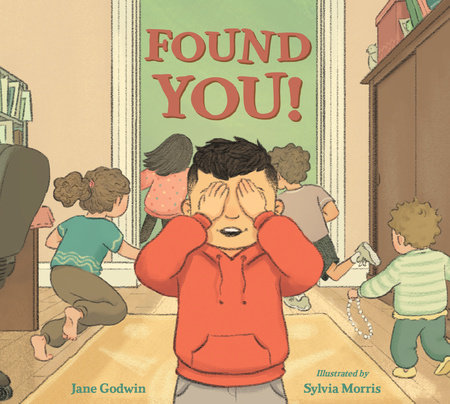
Jane Godwin’s Found You! illustrated by Sylvia Morris, opens with a group of kids playing hide-and-seek. A boy named Archie struggles to come up with a hiding spot, eventually settling into a cupboard. The quiet pages that follow build suspense; the reader hides alongside Archie, who feels his heart beating, hears sneakers squeak on the stairs. Godwin’s text is visceral and lyrical. Archie’s “whole body listens. There’s a bird, a car, a rattle in the wall, music somewhere far away, a lawn mower.”
The tone shifts as Archie’s thoughts turn to more worrisome things, like spiders and being forgotten by his friends, while on alternating pages Morris’s art provides a warm, comforting backdrop that shows the other kids looking for him. There’s an existential quality to this moment, as if it’s Archie’s first encounter with the wonder and discomfort of solitude. When he’s finally found, he’s elated that he hasn’t been forgotten after all.
Found You! is a thoughtful examination of how powerful it can be to spend time by ourselves and recognize our autonomy, but also how important it is to know we’re never truly alone.
—The New York Times Book Review
During a game of hide-and-seek, a youngster worries that he’s concealed himself too well.
In this Australian import, four kids scatter while another counts to 10 before shouting the familiar childhood phrase: “Coming! Ready or not!” Archie, a tot in a bright red pullover, sneaks into a cupboard. One by one, each child is found until only Archie is left. In his hiding spot, Archie wills himself to stay calm and not make a sound. But then the others go outside to search, and Archie’s cupboard starts to feel constricting. The house is quiet, and Archie wonders if they’ve stopped searching. “I’m still here,” he whispers. “Come back. Find me.” It’s thrilling to be the last one found, but the joyful game also has its scary moments. Many kids will relate to Godwin’s exploration of Archie’s emotional arc. Morris’ muted palette gives her artwork a serene feeling, but the layouts add dramatic tension. Several pages feature smaller panels showing hiding spots, as well as a zoomed-out look at the entire house that shows others being found. The darkness is also heightened in many scenes, with slivers of light serving as the sole saving grace in the increasingly ominous-looking cupboard. The kids have light tan skin; two (including Archie) appear to be East Asian.
A gently reassuring look at the big feelings elicited by a classic childhood game.
—Kirkus Reviews







 QUICK VIEW