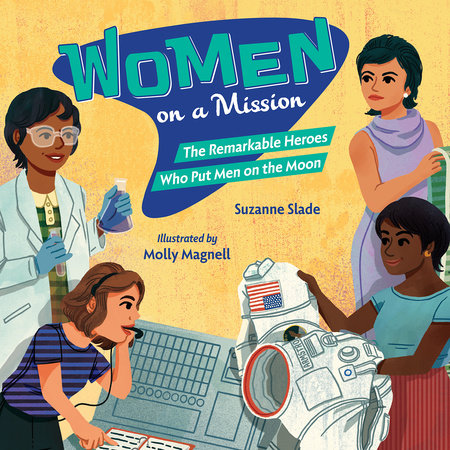
♦ A brilliant and brief record of the lives of 12 women who made the Apollo missions possible. A dozen exceptional women in various fields of work are highlighted in this collective biography, from mathematician Katherine Johnson to food scientist Rita Rapp. From planning, liftoff, and landing, no part of the Apollo missions happened without the direct impact of these highly intelligent women. While most early NASA missions are remembered by such historic moments as a man walking on the moon, it was the women left back on Earth who made this incredible journey possible. Cherokee Nation member Mary Golda Ross helped develop the first planetary flight handbooks; master organizer and analyzer Josephine Jue made history behind the scenes in a world mostly dominated by men. Brief professional biographical summaries are offered for each woman along with a related quote. Retro styling and formatting are paired with photographs and cheery illustrations.
VERDICT A remarkable tribute to those who made space travel possible in unexpected ways, this is a highly recommended STEM purchase to inspire a new generation of women.
—School Library Journal, starred review
♦ Before men walked on the moon on July 20, 1969, the 400,000 members of Team Apollo—thousands of whom were women—worked to get them there. This in-depth look at what went into the Apollo 11 launch and return, written by a mechanical engineer, showcases 12 of these pioneering women. At a time when women were discouraged from pursuing engineering, math, or science careers and long before girls could dream of becoming astronauts, these women braved sexism and racism in education and career choice to become part of Team Apollo. Each Apollo 11 mission component, including plotting a flight path, designing the rocket and lunar module, engineering video and communications, and ensuring a safe return, is embodied by the story of one woman crucial to the mission’s success. We meet, for example, a Native American aerospace engineer, a Black chemist who helped develop safe rocket fuels, and a Black seamstress who designed spacesuits that could withstand deadly radiation and micrometeoroids. The illustrations include photos from the time and pull quotes from the Team Apollo women, and the lettering has a cool sf vibe. The myriad dangers facing the mission fill the stories. Inspiring for all, but especially for STEM students.
—Booklist, starred review
Salutes to 12 women who made significant contributions to the Apollo program.
Black “human computer” Katherine Johnson is likely to be the only name on this roster familiar even to well-read young students of the early space program. But after interviewing surviving subjects or their families and delving into oral histories and published accounts, Slade has provided readers with 11 more women who were active members of Team Apollo, including thermochemist and rocket fuel expert Reatha Clark King; aerospace engineer Mary Golda Ross, co-author of NASA’s planetary flight handbook and member of the Cherokee Nation; and Yvonne Young Clark, who earned a degree from Howard University in mechanical engineering and went on to design the “rock box” astronauts used to collect lunar samples. Along with capsule accounts of their lives and specific achievements, the entries include a variety of photos, peppy direct quotes, and Magnell’s painted views of the subjects at work in labs, offices, and control rooms. The author concludes with a shoutout to Sally Ride and the rest of the first class of women astronauts. As she notes, these lesser-known figures, too, “are heroes whose stories need to be told!”
Totally justified, if tardy, tributes to women who also had the “right stuff” to take us to the moon.
—Kirkus Reviews







 QUICK VIEW