Best Seller
Ebook
Available on Apr 21, 2026 | 224 Pages
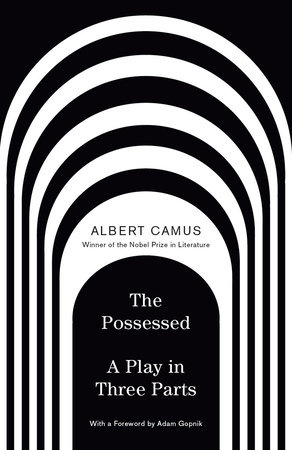
The Nobel Prize–winning author here adapts Dostoyevsky’s masterpiece for the stage—a rousing invective against nihilism that brings together two of the great literary minds of the last two centuries
When Albert Camus first read Dostoyevsky as a twenty-year-old philosophy student, it was a “soul-shaking experience.” The Possessed, in particular, had a profound effect on the young writer and thinker, who found in the novel an echo of his own disdain for the philosophy of nihilism and its potentially disastrous effects. “In many ways,” he writes in the foreword to the play, “I can claim that I grew up on it and took sustenance from it. For almost twenty years, in any event, I have visualized its characters on the stage.”
To complete this labor of love, Camus drew on hundreds of pages from Dostoyevsky’s The Notebooks for The Possessed, which document the Russian master’s torturous writing process, taking care all the while to preserve the “thread of suffering and affection that makes Dostoyevsky’s universe so close to each of us.” As a result, he breathed new life into the enigmatic Stavrogin, the gentle Shatov, and the God-haunted Kirilov, bringing us face to face with Dostoyevsky’s creations.
When it was finally performed, in 1959—with Camus himself directing—the play ran to four hours long and was an artistic and technical triumph, featuring thirty-three actors and seven sets. The last finished work before Camus’s death, The Possessed stands as an enduring literary statement about human existence in which the conscience of the twentieth century meets and defines in contemporary terms the conscience of the nineteenth century.
When Albert Camus first read Dostoyevsky as a twenty-year-old philosophy student, it was a “soul-shaking experience.” The Possessed, in particular, had a profound effect on the young writer and thinker, who found in the novel an echo of his own disdain for the philosophy of nihilism and its potentially disastrous effects. “In many ways,” he writes in the foreword to the play, “I can claim that I grew up on it and took sustenance from it. For almost twenty years, in any event, I have visualized its characters on the stage.”
To complete this labor of love, Camus drew on hundreds of pages from Dostoyevsky’s The Notebooks for The Possessed, which document the Russian master’s torturous writing process, taking care all the while to preserve the “thread of suffering and affection that makes Dostoyevsky’s universe so close to each of us.” As a result, he breathed new life into the enigmatic Stavrogin, the gentle Shatov, and the God-haunted Kirilov, bringing us face to face with Dostoyevsky’s creations.
When it was finally performed, in 1959—with Camus himself directing—the play ran to four hours long and was an artistic and technical triumph, featuring thirty-three actors and seven sets. The last finished work before Camus’s death, The Possessed stands as an enduring literary statement about human existence in which the conscience of the twentieth century meets and defines in contemporary terms the conscience of the nineteenth century.
Author
Albert Camus
ALBERT CAMUS was born in Algeria in 1913. He spent the early years of his life in North Africa, where he became a journalist. During World War II, he was one of the leading writers of the French Resistance and an editor of Combat, an underground newspaper he helped found. His fiction, including The Stranger, The Plague, The Fall, and Exile and the Kingdom; his philosophical essays The Myth of Sisyphus and The Rebel and his plays The Just Assassins, The Misunderstanding, and Caligula have assured his preeminent position in modern literature and philosophy. In 1957, Camus was awarded the Nobel Prize in Literature. On January 4, 1960, he was killed in a car accident.
Learn More about Albert CamusYou May Also Like
Miguel Street
Paperback
$16.00
Flying Home
Paperback
$21.00
Between Father and Son
Paperback
$19.00
Don’t Tell Alfred
Paperback
$19.00
Mon Cher Amour
Hardcover
$60.00
Myra Breckinridge
Paperback
$18.00
Christmas Pudding and Pigeon Pie
Paperback
$21.00
I Love a Broad Margin to My Life
Paperback
$18.00
The Riddle of Gender
Paperback
$21.00
×