




READERS GUIDE
A Conversation with Bobby Finger about We Are Gathered Here TodayIn your own words, tell us what We Are Gathered Here Today is about.
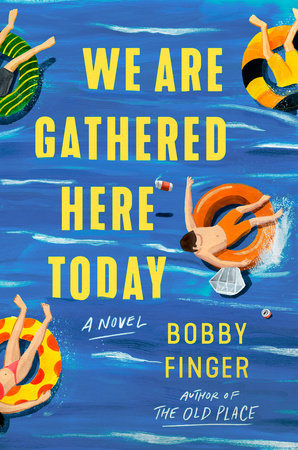
We Are Gathered Here Today is about a meticulously planned destination wedding weekend at a Wild West–themed venue in central Texas, and follows one of its guests (who is also the officiant and cousin of the bride), Finlay Hightower, as he reconnects with old friends, attempts to make some new ones, and grapples with his ever-evolving views on marriage. He’s just accepted the proposal of his boyfriend, Mark, who is unable to attend due to a work conflict, but Fin keeps their engagement a secret from the other wedding guests. Like most weddings, some things go as planned, others devolve into chaos, and relationships (both old and new) become strained and strengthened.
More broadly, it’s about how the legalization of same-sex marriage affected queer people (some embraced the idea while others rejected the institution that had long rejected them). It’s about how every gay marriage is a little straight, and it’s about how every straight marriage is a little gay. It’s about how every wedding is worth attending, even if it’s an unmitigated disaster. Finally, since I should get to the actual plot, it’s about six people seated at the “queer table” getting to know one another at a straight wedding in Texas.
We Are Gathered Here Today is your third novel. It’s also the second novel you’ve set in Billington, Texas. What inspired you to write this story, and why did you decide to revisit this southern setting for this next book?
Billington is based on the actual town where I grew up: D’Hanis, TX. (Pronounced Dee-hen-iss, by the way.) I actually first conceived We Are Gathered Here Today the last time I visited D’Hanis back in 2023. Though I’d never intended on setting another book in Billington, something about that visit—wandering through the ruins of the old church, walking through the cemetery I went to so often as a child to visit family members who had passed on, and driving through the beautiful pastures and farmland north of town (where The Hill Country Hideout is located)—was so emotionally overwhelming that I had to set another novel there. Something about memory, family, love, aging, and uncertainty . . . sounds like a wedding book to me!
Though We Are Gathered Here Today largely follows Fin—a recently engaged gay man navigating his cousin’s chaotic wedding weekend—it also features a diverse and zany cast of wedding guests. How did you craft these nuanced characters? Were any of them based on real people? Who was your favorite to write, and why?
I looked into my history as a wedding guest and plucked out the most notable wedding “types.” The gregarious ones, the introverted ones, the sloppy ones, the judgmental ones, the fast friends, and the people you cannot wait to be rid of after the vows are recited. I wanted all of them not only to have distinct views on the institution of marriage, but also concrete personal histories that explain them. We may only know our wedding friends for a short time, but I wanted the readers to feel like they’ve known everyone for a lifetime.
Only one character was directly based on a real person. Thomas Wheeler, a late relative of Fin’s, was based on a distant relative of mine, Clemens Finger. He was a lifelong bachelor who died at ninety-seven. (I found that interesting . . . ) In fact, the idea for the book bubbled up when I saw his gravestone during my last visit to D’Hanis. While roaming the cemetery with my parents, I stumbled upon Clemens’s final resting place. Its bio was just one line: “Beloved prophet, poet, sage, and wit.” What must he have been like? And why was his grave one of the only in the row without a partner by his side?
In short, the book is based on every wedding I’ve ever attended (or had recounted to me) and also none of them. I hope it’s instantly recognizable to anyone who’s ever watched another couple say “I do” from an uncomfortable folding chair.
The Hour of Disrespect—Fin and his friend’s pact to reserve judgement for only one hour after a wedding—is such a fun and relatable tradition woven throughout the novel. Is this based on a real ritual from past wedding seasons, or an invention of your imagination? How do you think it helped inform this story and Fin’s journey?
“The Hour of Disrespect” is a tradition I created long, long ago while at a destination wedding with a group of close friends. Like all weddings (my own included), it had its roses and thorns, and setting a specific time to share our unfiltered opinions of the event was fun, of course, but also clarifying in that it helped me understand what I can learn about love, marriage, and relationships in general from simply attending a wedding.
“The Hour of Disrespect” is an exercise that is as delightful as it can be toxic, if not done the right way. Yes, it’s true that by siloing the airing of grievances in a specific hour you can keep positive and joyful during the wedding, but isn’t it also possible that preparing for such disrespect—turning it into your group’s own Big Event—condition you to focus on the things worth disrespecting instead? Maybe it makes you less aware of all the stuff that’s worth remembering fondly! Complaining can be fun, but it can also be a crutch. Fin and the queer table learn this over the course of the novel.
Each person at the “queer table” ruminates on and shares their own complicated feelings on love, marriage, and weddings. You even share the wedding planner’s perspective! Why was it important to include each of these different views, and how do you feel they aided in Fin’s own coming-to-self journey?
As much as I love my own queer marriage, I’m not naive enough to think it’s for everyone. Some queer people are dying to get married. Some queer people think marriage is archaic and repressive. Plenty of queer people think marriage requires monogamy, while plenty more disagree.
All this to say, I think there was a time in the very recent past when people were meant to assume that every marriage was exactly the same. These days, the infinite ways to be happily married is something people discuss more openly, which is both liberating and, in Fin’s case, anxiety-inducing. I wanted to showcase as many opinions and types of marriages and relationships as I could in order to prove to the reader—and to Fin—that there’s no right way to be married. There’s only the way that makes both members happy.
Without giving any spoilers, what was your favorite scene to write, and why?
The scene on the river. Tubing down the Medina or Guadalupe is one of my favorite activities in the world, and something that just feels so . . . Texas to me. I regret not going more before moving to New York in my twenties, and writing this scene let me experience that wonderful feeling from two thousand miles away.
As weddings continue to evolve, what is one ritual you would like to see go and one you’d like to stay? Are there any you did for your own wedding that you look back on fondly or cringe at?
As for one wedding ritual that needs to stay . . . If “I Wanna Dance with Somebody” doesn’t play at your wedding, then you’re not actually married. I remember a moment during my wedding when the DJ, bless his heart, was playing extremely odd music from his vinyl collection that no one was dancing to. I said, “You need to play ‘I Wanna Dance with Somebody’ NOW,” and people instantly rushed back to the dance floor. But actually, the best part of my wedding reception was when the DJ played Lady Gaga and Bradley Cooper’s “Shallow.” A Star Is Born had come out two days before the wedding, but all the guests sang along like they’d known it for decades.
A ritual I’d like to see banned from all weddings for the rest of time is the removal of the garter. To be perfectly frank, it makes me want to vomit.
Was there any part of the writing process—from characters to plot and story reveals—that surprised you? Did you always know how the story would end?
This novel was originally bookended in a way that gave it an entirely different tone. It was somehow darker and funnier (read: a tonal mess) until my agent and editor convinced me to—how do I put this without spoilers—make some fundamental changes. When I really dug into the manuscript after those notes, I didn’t quite know how things would end for Fin until the second or third draft—which was the longest it had ever taken me that long to nail down an ending for a novel. What was originally more ambiguous transformed into something more definitive, and I think, satisfying, while maintaining that slight feeling of uncertainty that comes with any aspect of life. Hope, after all, is impossible without it.
What do you want readers to take away from We Are Gathered Here Today?
Marriage is not for everyone, but weddings absolutely are.
What are you working on next?
Would you believe it’s a gay murder mystery?
Discussion Questions
1. In We Are Gathered Here Today, Fin and the queer table share many revelations on marriage and wedding culture as they participate in Elaine and Rupert’s wedding weekend antics. What are your own personal views on these institutions? Did you find yourself resonating with one character’s experience and views in particular, and if so, how?
2. Discuss the ways in which each of the queer table characters inform Fin’s own views on marriage and weddings. How did Fin’s perspective evolve throughout the novel? What do you think ultimately brought him to his truth?
3. Who was your favorite character in the novel and why?
4. Elaine and Rupert choose a Wild West–themed wedding venue in the scorching Texas heat for their Big Day. How do you think this unique setting played a role in Fin’s and the wedding guest’s experiences and coming-to-self journeys? Share the zaniest or most memorable wedding you’ve been to and why it was so unique.
5. How many weddings have you attended? Did you ever unknowingly participate in an “Hour of Disrespect” with friends? If so, share one of your experiences. Do you feel the same about those thoughts today as you did then?
6. What was your favorite scene in the novel and why?
7. Discuss the ways in which family generational patterns and childhood experiences affected Fin, the queer table, and even Elaine’s views on marriage. Do you think your own views on love and commitment are influenced by your family, or examples you grew up observing? If so, how and why?
8. On page 181, Fin says, “Weddings are all about time . . . They’re big stories about the past, how people met and how they were raised and who they’ve loved, plus, you know, the future. The promise of forever. You can’t go to one without thinking about your own life, all the choices you’ve made, all the choices you’ll keep making.” What do you think he means by this? Do you agree with this sentiment? Why or why not?
9. Discuss the heteronormative nature of weddings and how they have evolved over the years. In what ways are they fun, ridiculous, entertaining, and special? What are your favorite and least favorite wedding rituals, and why?
10. What were your thoughts on the ending? If you had to guess, where do you see each of the queer table guests (Fin, Jacque, Marina, Tom, and David) in one year?