Our Culture Magazine, A Most Anticipated Book of Fall
“Ms. Antonetta calls for doctors to pay closer attention to what their patients are experiencing, even, or especially, if it seems delusional or disordered. She reminds us that the line between sanity and madness can be both fine and, depending on social context, changeable . . . The moral challenge Ms. Antonetta identifies is with us still—in new forms . . . When the time comes, these words from Ms. Antonetta will merit consideration: ‘Programs of euthanasia and sterilization don’t just live in the past, terrible but finished. Their aftershocks are terrible and here.'” —Charles Lane, The Wall Street Journal
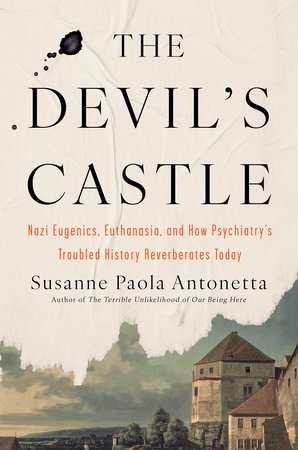
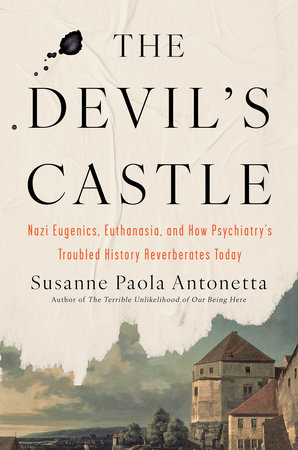
“The Devil’s Castle is a very important and informative book . . . This book will be of special interest to scholars of Nazism, the history of medical ethics and practices during the Reich under Hitler, and other World War II atrocities.” —Louis R. Franzini, Pittsburgh Post-Gazette
“A compelling overview of the history of psychiatry and its place in the Nazi regime . . . Antonetta outlines rehearsals for death on a mass scale, from shootings to injections to gassings, with protocrematoria to dispose of the remains. But she also reminds us through her personal story and her examination of psychiatry itself, that while the T4 program is a horror of the past, it casts long shadows, with deep implications and indeed echoes in the practice of psychiatry today.” —Sharrona Pearl, Lilith
“The Devil’s Castle is a sobering and disheartening—yet important—text. It shines a light onto a neglected history of World War II and onto a population that, too, has been neglected and mistreated.” —Benjamin Selesnick, Jewish Book Council
“Poet and memoirist Antonetta offers a striking study of the evolution of modern psychiatry . . . Unique in its tone and its passion, this is an arresting and deeply resonant book.” —Publishers Weekly (starred review)
“A solid history of eugenics that calls for compassion.” —Kirkus Reviews
“Susanne Antonetta draws memories from histories of oppression, violence and brutality in past psychiatry in Europe. And she connects these to the contemporary state of American psychiatry in a personally driven narrative. In a compelling style, she maintains the precarious balance between substantive engagement and anger, and ironic distance. This is an obligatory page-turner for anyone interested in the downside of the smug success stories of medical science.” —Wouter Kusters, author of A Philosophy of Madness: The Experience of Psychotic Thinking
“As always, Susanne Antonetta treats the darkest and most persistently dangerous foundations of neuronormative humanity with a combination of terrifying clarity and redemptive tenderness. This forced reflection is as terrible as its distilled agony and as persistently poignant as a late-spring flower. I would, without hyperbole, call her the greatest writer of the century—but her encompassing expressions defy human ideas of time and space. I am proud to share the same mad soul.” —Dawn Prince-Hughes, author of Songs of the Gorilla Nation: My Journey Through Autism
“In The Devil’s Castle, which no one else could have written, Susanne Antonetta uses, like her heroes Paul Schreber and Dorothea Buck, her own ‘mad career’ to advocate ‘letting go of the madness of fearing madness.’ Only by confronting the murderous inhumanity of German and American eugenics and by acknowledging their all too living embers in the fireplace of contemporary psychiatry, can we leave the pathology paradigm for good. We needed an exquisitely talented poet and nonfiction writer, in possession of scrupulous research skills and a fair-minded activist bent, to point us toward ‘living image[s] that . . . do psychic work.’ I couldn’t put The Devil’s Castle down. It’s an extraordinary book.” —Ralph James Savarese, author of See It Feelingly: Classic Novels, Autistic Readers, and the Schooling of a No-Good English Professor
“Poetic, shocking, darkly illuminating and deeply optimistic—The Devil’s Castle offers a powerful rallying cry for us to cherish the diversity of minds that enrich our societies and our worlds. An important and timely book.” —Anil Seth, author of the international bestseller Being You: A New Science of Consciousness
“The Devil’s Castle is an essential read for anyone seeking to understand the deeper complexities of the Holocaust and the historical context that allowed such horrors to unfold. It is a compelling and necessary addition to the discourse on human rights and dignity. Prepare to be challenged, moved, and forever changed by this extraordinary work.” —Sandy Bourque, producer of CBC Radio IDEAS documentary series “Myth of Normal”






 QUICK VIEW