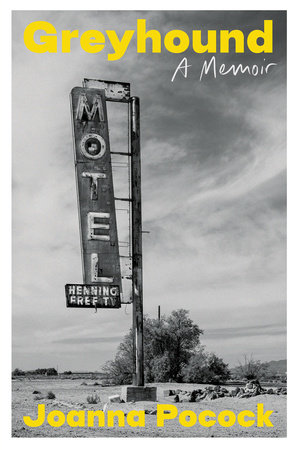
Finalist for the NBCC Award for Criticism
Literary Hub, A Most Anticipated Book of the Year
“An engaging combination of the profound and the profane—much like the country Pocock traverses.” —Bridget Bentz, NPR
“It is a testament to Pocock’s subtlety and skill that Greyhound can do so much without flashing neon signs over the various points it makes. Transitioning with deceptively light grace through its many significant subjects, the book flows like scenery past a windshield . . . Lyrical and clear-eyed at once, Pocock has reinvented the road-trip genre for a new age.” —Melissa Holbrook Pierson, The Washington Post
“The Great American Road Trip, that idealized trek heading west, might be different now, according to author Pocock, who first made that journey in 2006 from Detroit to Los Angeles in the wake of grief after several miscarriages. In 2023, retracing her steps via Greyhound bus like French writer Simone de Beauvoir, she discovers fewer humans, more dirt and less safety—but the same magical ‘sense of no longer existing.'” —Bethanne Patrick, Los Angeles Times
“Greyhound spins a memoir around [Pocock’s] two epic journeys on America’s legendary buses, one done in 2006 and one in 2023. Her reflections on the changes between those two years are fascinating . . . I’ve done my time on those iconic buses too, so being lured down that rabbit-hole (or hound-hole) by Pocock was a great pleasure.” —Sarah Bakewell, New Statesman
“This ambitious book asks important societal questions and is astute in its depictions of public living . . . Traversing urban metropolises and desert vistas, Greyhound is an erudite study of how living among others became a dying art.” —Ellen Peirson-Hagger, The Observer
“Greyhound is a road trip like no other . . . Pocock’s rage is infectious and energising; her prose vivid. In unexpected places she finds kindness and generosity. There is both darkness and brilliance here: affection and laughter brighten the pages of this fierce, accusatory, tender and unforgettable book.” —Lee Langley, The Spectator
“The book’s final, essential plea—to recognize what the Greyhound, for all these reasons, can uniquely offer—is ambitious and earnest. In this westward journey, Pocock seeks not fortune, success, or survival, but connection, in all senses of the word: for her own sake but also, more urgently, as a balm for America’s pervasive ills to which her bus ride grants her a front-row seat.” —Maisie Hurwitz, Alta
“[An] increasingly essential writer . . . Pocock’s method is that of the documentarian—she approaches her chosen subject with unblinking focus and a fierce, interrogative energy . . . Greyhound develops Pocock’s voice in compelling fashion.” —Gary Kaill, The London Magazine
“[Pocock is] good company, divulging the grimness of American cities and the bus-ride experience, relating the eavesdroppings, humorous and otherwise, and random encounters that are a central part of long bus journeys, while sharing her reflections on race, gender, environmental disasters and ‘appification’. . . Travel—as in, the leisure business, the inanity of the bucket-list and the surfeit of social media sharing and comparing—hasn’t changed as much post-pandemic as many people expected, as much as it should have done if the world is to get a grip on the climate crisis. But travel writing does seem to be changing, as women write more, from different angles, about different places and experiences. Greyhound is a prime example of a flourishing new genre.” —Chris Moss, Tribune Magazine
“An illuminating, troubling portrait of a slice of the population whose precarity refutes the American Dream more and more each year . . . In choosing to take Greyhound, [Pocock] had a degree of privilege that set her apart, but she wonders, ‘How important is comfort when it relies on extraction and exploitation for its existence?’ Incisive thoughts like this one, as well as Pocock’s deep empathy and curiosity, made me want to sink into Greyhound and enjoy the ride.” —Dan Rubinstein, Literary Review of Canada
“[Greyhound] uses its ecological consciousness to direct readers’ attentions to the natural world, thoughtfully probes the boundaries of its own awareness, and honestly struggles to achieve a comfortable sense of place . . . It ends with a pledge to continue cultivating a sense of belonging and a feeling that, for Joanna Pocock, ‘home’ may involve a set of ongoing practices rather than something she achieves once and for all.” —Dan Kubis, Chicago Review of Books
“With clear eyes Pocock observes and reports from America’s interstitial spaces, its abandoned detours and dark medians, revealing a country of wild and violent edges that somehow still suffers beauty in its midst.” —Jonny Diamond, Literary Hub
“[Pocock’s] notes on the sad condition of American society are invaluable . . . This rare account of a woman traveling alone, and in some of the most desperate corners of the American landscape, is well worth reading. A pensive, clear-eyed vision of a collapsing world as seen through grimy, rain-streaked windows.” —Kirkus Reviews
“Joanna Pocock’s Greyhound is an intimate epic, and a fierce mirror held to our U.S. ecological and sociological present such as only a visitor, seemingly, can provide. The thinking is scrupulous, the writing scraped and glinting and as stark as the landscape. This book kept me up all night and will stay with me.” —Jonathan Lethem
“Pocock reveals a complicated American landscape from the shabby seats of Greyhound buses and through a pinhole of grief as she retraces her past and a country’s past and finds suffering and redemption in both. She is at the mercy of the communities and the country she encounters, which, like the nation itself, is also in gripped in its own reckoning. Like Denis Johnson’s Angels and Jonathan Raban’s Bad Land, Greyhound finds truth and decency in the unglamourous and shows how the United States has perhaps always been on unstable soil.” —Kerri Arsenault, author of Mill Town
“Greyhound is an instant classic, a chronicle of desperation, anger, and violence, as well as the luminous beauty and humanity that four decades of neoliberal looting have been unable to kill off from the American countryside. Pocock’s eye is sharp and her prose crackles with wistfulness, fleeting camaraderie, and vitality. Not since William Least Heat-Moon’s Blue Highways has a book so captured the feeling of the road.” —Daegan Miller, author of This Radical Land