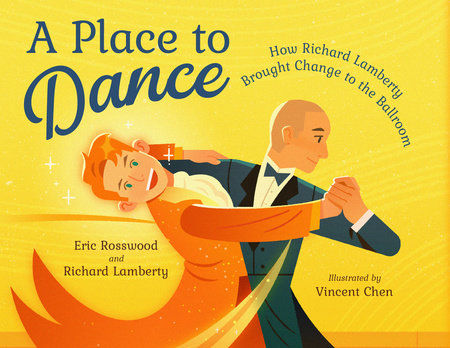
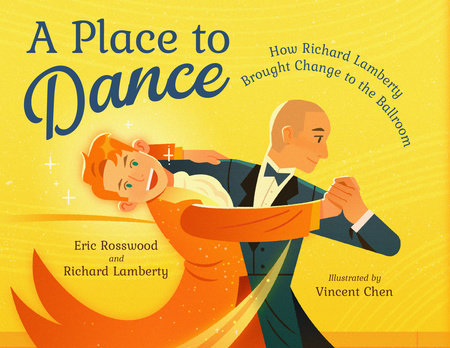
♦ Evocative language, such as “skip, spin, twirl, prance, and strut” brings this story of a young dancer to life. Joy can become a form of resistance, as shown in this biography. From childhood, Richard Lamberty recognizes dance as an authentic expression of self, even when adults attempt to temper or redirect that impulse. The narrative follows how that early certainty evolves into advocacy, culminating in his founding of April Follies to legitimize and expand opportunities for same-sex ballroom competition. What begins as personal passion becomes public work. Dance is presented as both disciplined craft and cultural intervention, challenging restrictive norms and widening the circle of belonging. Chen’s digital illustrations heighten this sense of movement and intention. Sweeping lines carry the eye across each spread, capturing lift, extension, and precision, allowing readers to feel the movement of dance through the illustrations. Saturated jewel tones and warm golds evoke stage light and celebration without veering into excess. The characterization feels contemporary and accessible while maintaining elegance. VERDICT An uplifting and thoughtfully rendered portrait that affirms how artistic conviction can reshape tradition and expand possibilities for inclusion; a necessary purchase.
—School Library Journal, starred review
♦ Long-limbed, elegantly posed couples glide lyrically through this salute to Richard Lamberty, who helped pioneer the notion of same-sex ballroom dancing in this country. Readers will be swept along both by the art and by his story, which begins with him as the shortest first-grader, leading his class down the hall in glides and twists, clogging his way across the lunchroom, and jealously noting how only the girls at ballroom-dance camp got to spin, twirl, and dip. At 16 he was already teaching; a little later, he and a partner placed third in the world at the international Gay Games. In 2003, he cofounded “April Follies,” still the “largest and longest-running queer dance competition in North America.” Rosswood explains in a historical afterword that only in 2019 did a rules change allow same-gender couples to compete in “mainstream” ballroom events. “So, be yourself,” Lamberty concludes. “Be proud. And keep on dancing!” Considering the joy of movement that positively shines in Chen’s exuberant images of couples mixed of both race and gender twirling across the floor, it would be hard to do otherwise. The closing lists of kid-friendly print and web resources are excellent too.
—Booklist, starred review
Under studio lights and strict rules, a young dancer refuses to stay in step.
This picture-book biography, co-authored by its subject, focuses on the life of dancer Lamberty (b. 1959). As a teen, he falls for ballroom—jive, rumba, cha-cha—but bristles at the rigid roles that reserve all the fun flair for girls. Though his teachers shut him down, he practices both parts in private, twirling and dipping on his own. That determination sharpens his skill and leads to a job teaching dance, yet he still longs to perform freely. Years later, he spots a flyer for the Gay Games in Amsterdam. Finding a partner proves difficult at a time when many fear being openly themselves, but Richard persists. When he finally competes, he and his partner Tom place third in the world. The experience affirms what Richard already knows: If a true space of belonging doesn’t exist for him, he must build it from the ground up. He leans into queer advocacy and creates April Follies, an inclusive competition that welcomes dancers as they are. Chen’s digital illustrations feature fluid shapes and luminous gradients that convey motion and joy. Ribbonlike color sweeps guide the eye, while Richard seems to glow brighter than all those around him, capturing his spark. Richard is white, and the book’s ensemble visually reflects a wide range of identities.
A poignant reflection on joyful resistance.
—Kirkus Reviews