“’Cutting down a large tree should be an act charged with ritual.’ Why? Farming columnist Logsdon points to the tree’s ‘wonderful accomplishment’ and to its ‘feat of survival’ as models for ourselves. Then he goes on to discuss ways of felling trees that have come to the end of their lives and can therefore spare their wood for fuel. This collection of essays recommends cottage farming–the small-scale, part-time growing that aims to reduce food expenses and increase pleasure in living–in a tone that combines even-handed pragmatism, idealism (‘Measure the value of products in human terms,’ he urges) and impatient realism (‘Let those who put their faith in fancy threads laugh at your jeans’). The author rejects “institutionalized claptrap” for the greater benefits of rural independence and freedom, and outlines ways we can pursue these. ‘Flee the evils that centralized power always generates,’ he advises, calling himself an investor in ‘the tools that make sweat more productive.’ Logsdon raises a sanely unruly voice in a society where life too often only seems civilized. His correctives are not easily applied, but their promise and appeal (like his own) are powerful.”—Publishers Weekly
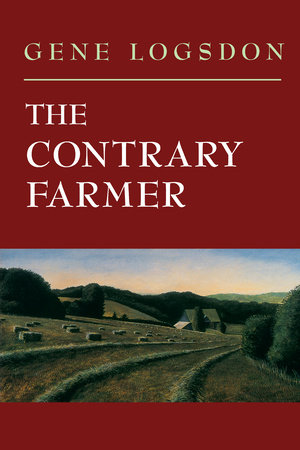
“Logsdon is a writer for New Farm magazine and author of several books on small-scale farming and American agriculture, including At Nature’s Pace: Farming and the American Dream. He is also a farmer, and experiences from his small Ohio farm provide much of the the subject material for The Contrary Farmer, which explains how he deals with crops, animals, machinery, the weather, and the neighbors. Just what is a contrary farmer? Among other things, one who is not afraid to go against the grain of conventional agricultural wisdom, who does not believe that bigger is always better or that no-till chemically maintained monocultures are superior to crop rotations and diversified farming. Logsdon is as staunch an advocate for the small family farm or acreage (‘cottage farm’ in his parlance) as you are likely to find. His latest book is thoughtful, entertaining, often irreverent, and brimming with ideas and practical advice.”—Library Journal
“No learned gentleman farmer, Logsdon earns his moments of lyricism by analyzing at length the daily demands on the cottage farmer (one whose holdings are much smaller than the 50 acres that economists deem ‘small’). He recommends alternatives: ways to avoid backbreaking work, to use gardens to test prospective crops, to ameliorate the ‘gruesome’ tasks of butchering and tail docking, to access water for irrigation, to avoid the pitfalls of ‘controlled rational grazing,’ to determine the most functional crop for the working cottage farm (it’s corn), and so on. All this by a man who also reads widely and has a down-home sense of humor, as well as no reluctance to express his opinions. So if at first you think that these farming essays are too technical for you, you’re wrong. ‘Yeah, I could do that–avoid buying gadgets I don’t need, be a lender rather than a borrower, live near a village where I can buy a home for $40,000,’ we muse, even if eventually we hear from Logsdon that we must ‘learn to fix cars and tractors’ ourselves, and sigh, ‘Too much, too much.’”—Booklist







 QUICK VIEW