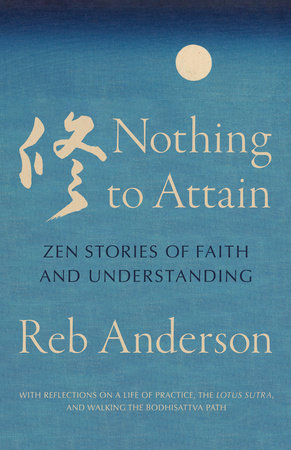
“Tenshin Reb Anderson, one of the most important Zen teachers of our age, places the famous Lotus Sutra parable of the lost and destitute child at the center of a matrix of teachings that guide the reader to a realization of one’s true nature and original home. As he develops this text, he weaves in marvelous anecdotes from his own long, adventurous, and dedicated life, demonstrating how deeply he understands what it means to be a ‘destitute’ and wandering child, spiritually. His commentary is both clear and subtle, not falling into prescriptions for practice, yet lighting the way to recognizing the bodhisattva path to one’s own homecoming.”
–Konjin Gaelyn Godwin, abbot of Houston Zen Center & Auspicious Cloud Temple,
Director, Soto Zen Buddhism North America International Center
“This powerful book is a profound and timeless offering to all practitioners of the dharma, and truly for all of us who are committed to end suffering in our world in a non-transactional way. As Tenshin Anderson shows us, ‘Bodhisattvas have nothing to attain and everything to realize.’ This is a courageous and wise call in today’s world, a call that is important for us to heed. As the author’s second dharma name, Zenki, reflects, this is ‘the whole works.’”
–Roshi Joan Halifax, abbot of Upaya Zen Center, Santa Fe, NM
“Reb Anderson’s beautifully written book takes perhaps the most important ‘meta-koan’ of Zen practice—that beneath all of our ardent striving there is actually nothing to attain—as a guide through a series of wonderful stories, illuminating many of the most salient dimensions of the Buddhist path. This is clearly a book arising out of decades of profound practice and insightful teaching.”
–Dale Wright, professor emeritus of religious studies and Asian studies, Occidental College, author of What is Buddhist Enlightenment?
“A voice of upright Zen, Tenshin Reb Anderson Roshi spectacularly reflects his life story of authentic practicing and teaching Zen meditation, which I have closely witnessed for fifty years.”
–Kazuaki Tanahashi, editor of Treasury of the True Dharma Eye: Zen Master Dogen’s Shobo Genzo
“By weaving together tales of his own practice in Suzuki Shunryu’s lineage with Lotus Sutra parables and reflections on a bodhisattva’s teachings and training methods offered by Dogen, Dongshan, and numerous other traditional luminaries, Reb Anderson’s new book is a fascinating and insightful account of how leading the Zen life becomes an ongoing experience of discovery about one’s true inner self or original face. Several decades in the making, Nothing to Attain unlocks the profound mystery of why Suzuki once instructed that his student’s dharma name, Tenshin, means ‘Reb is Reb,’ as well as the many intriguing ways in which Anderson rejoices today in this continuously renewed understanding.”
–Steven Heine, director of the Asian studies program, Florida International University, and author of Dogen: Japan’s Original Zen Teacher
“I recommend this book to all bodhisattvas practicing Soto Zen. I am glad that the dharma flower of the tree transplanted by Dogen Zenji in Japan is now blooming in the cultural soil of America. Bodhisattva practice is a journey to return home, where we are from. When we arrive home, we intimately practice with our teacher to inherit the Buddha’s wealth. Anderson Roshi clearly describes the process using many lively stories that reveal the family treasure from Suzuki Roshi.”
–Shohaku Okumura, former abbot of Sanshinji Zen Community, Bloomington, IN
“Nothing to Attain describes the inner workings of the Buddha Way, a treasure to inform all practitioners. As a central metaphor, Reb Anderson celebrates the prodigal son from the Lotus Sutra, who must shovel dung in his father’s fields until ready for his birthright. This metaphor echoes all our situations, born to the forgotten nobility of awakening in which we contain everything in the universe, and vice versa. There’s nothing separate to gain. Reb describes many personal anecdotes, from childhood through study with Suzuki Roshi to his years as abbot. For example, for Suzuki Roshi, a young Reb moved slightly a large rock in a garden all day, only for it to end up where it started. Reb cites many traditional koans, especially Yangshan’s, invoking the stage of faith and stage of person. We all are awakened from the beginning, only needing to realize this reality beyond our personal karmic entanglements.”
–Taigen Dan Leighton, guiding teacher emeritus of Ancient Dragon Zen Gate, peace activist, and author of Just This Is It: Dongshan and the Practice of Suchness, Dogen’s Extensive Record, and Cultivating the Empty Field: The Silent Illumination of Buddhist Master Hongzhi
“Be ready to work side by side with Reb Anderson as he compassionately shows us the way to shovel dung, muck out the stalls, and embody the practice revealed in the Lotus Sutra’s parable of the destitute child. Reb celebrates this parable and other Zen stories in deep and thorough conversation, often including intimate stories of practice life with his teacher, Shunryu Suzuki Roshi. In this way, Reb uncovers the family jewels and the mystery of the truth that there is nothing to attain—that our rich inheritance, our family treasure, is waiting for us to come home straightaway and receive it. ‘Haven’t you heard that the family jewels do not come through the front gate?’”
–Linda Ruth Cutts, former abbess of San Francisco Zen Center
“Nearly sixty years ago, Tenshin Reb Anderson stepped into a place of wonder called the San Francisco Zen Center. Inside the entry way was his teacher, Shunryu Suzuki Roshi, dressed all in black, silently and slowly walking toward the Zendo. Left foot, right foot . . . left foot, right foot. Having now written an account of his own travels through the wonderland of Zen in the footsteps of his teacher, Tenshin Roshi has chosen for us a story from the Lotus Sutra as a travel guide for that same journey. What are we going to find in a land where there is nothing to find? For me, a heartfelt gratitude for my own teacher living within the light of Suzuki Roshi’s awakened vision.”
–Furyu Nancy Schroeder, former abiding abbess at Green Gulch Farm
“Do you want to learn how to illuminate consciousness by shoveling dung? Would you like to find out how sluggish birds and exhausted fish become cranes and dragons? Do you wish to see delusion and wisdom intimately dancing together and liberating each other? If so, read this book. But don’t try to attain anything!”
–Linda Hess, senior lecturer emerita of religious studies, Stanford University







 QUICK VIEW