“I deeply admire her darkly gleaming sentences and the carefully calibrated silences around them.” —Ben Lerner
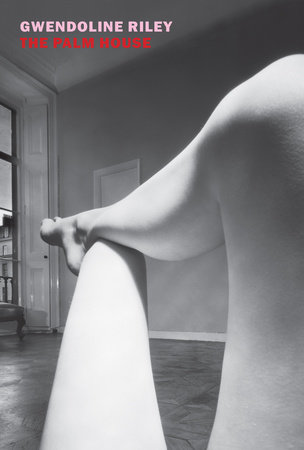
“[An] extraordinary writer . . . She’s a revelation . . . I’m gobsmacked by this book. I would never/could never cheat myself of the luxury and the deep pleasure of savoring every sumptuous word in Gwendoline Riley’s The Palm House.”
—Sarah Jessica Parker
“A note-perfect portrait of rarefied London intellectual spaces, and the people who make up that impersonal thing we think of as the Establishment. Minimalist, precise, and indelible.”
—The Booker Prize judges
“[Riley] eschews euphemism and writes in a stark, exacting prose that achieves a clarity of vision when it comes to human behavior. Among American writers, Riley resembles Lydia Davis for the fine calibration and fragility of her sentences.”
—Christian Lorentzen, The New York Times
“Riley is much too sharp a writer to pose and answer a single question in her fiction. Being inside her novels is a singular, spiky, often deeply funny experience. But, insofar as The Palm House casts its keen eye on men, it lingers on the ways that stories about heroes, about conquering and winning, about what men are owed and deserve, can be just as much of a trap as the stories told to women about what we are or aren’t.” —Lynn Steger Strong, The New Yorker
“Riley [is] among the best contemporary novelists working today… [The Palm House] is a delicate and autumnal novel, pared-back yet bristling with quiet tangents, about the mysteries of friendship and what it means to find yourself becoming history.” —Zack Hatfield, 4Columns
“The prizewinning author deploys language to devastating effect as she revisits her theme of women plagued by brittle relationships” — Jon Day, Financial Times
“Neatly and pertinently written” —D.J. Taylor, The Spectator
“Outstandingly brilliant.” —Claire-Louise Bennett
“Gwendoline Riley is one of my favourite contemporary writers and The Palm House is the book of hers I love the most.” —Sheila Heti
“For the past twenty-five years and in six slim, diaristic novels, Riley’s narrators have prowled a damp English corner of the Earth, armed with bone-dry observations and cool numbness, characteristically soused for good measure . . . The Palm House, her seventh novel, turns this method toward cultural and institutional decay and the question of what, if anything, can be saved. It’s tender for a Riley novel, offering a quiet redemption in enduring friendships, where understanding can still take root in rare, flickering moments.” —Janna Shaftan, The Baffler
“One has the sense, reading Riley, of being involved in an alarming experiment, that of reading the world without the slightest mercy or compromise. . . . We truly see her characters, in their descriptive nakedness, alive and horridly vivid.” —James Wood, The New Yorker
“Riley has occasionally been misread through a lens of trendy melancholia. But her work, especially since the breakthrough of First Love, more closely resembles the sturdy yet delicate realism of the 19th century—Chekhov, Stendhal—in which mundane objects, landscapes and exchanges are imbued with rich layers of social and psychological meaning. . . . Like Mary Gaitskill she is a moralist.” —Lidija Haas, The New York Times Book Review
“Riley has a spy’s attention to detail and a great and terrible power to re-create tics, pretensions, and the painfully recognizable human tendency to wallow in delusion.” —Rachel Connolly, New York magazine
“If you need any further proof that Gwendoline Riley is one of our finest prose stylists, look no further than her eighth book, The Palm House. She writes slender, scorching stories that capture the humour and pathos of ordinary English lives in unflinching detail and painfully funny dialogue.”
—Madeleine Feeny
“One doesn’t read Riley for plot; each book is an assemblage of episodes. She wields dialogue like a Swiss army knife, now corkscrewed, now serrated, but always coming to a short, sharp point . . . Riley’s prose, like a greenhouse, is equal parts brittle transparency and wrought-iron strength.”
—Ange Mlinko, London Review of Books
“Riley’s particular ear for linguistic nuance and eye for pinpoint detail are as distinctive as ever in her seventh novel . . . On one level, this is an account of an ordinary existence short on plot developments; on another, it’s a subtly calibrated observation of how a person’s world turns. Riley elevates the everyday to exceptional heights.” —Kirkus Reviews
“The Palm House might be my favourite novel of 2026 so far . . . It’s very funny and so full of pathos and horror. As ever, Riley’s cringe comedy is pitch perfect. The writing surprises but it’s always rooted in what feels true.” —Johanna Thomas-Corr, The Sunday Times (UK)
“Riley’s marvelous latest [The Palm House] . . . is a deeply sympathetic and thoroughly unpretentious portrait of literary life.” —Publishers Weekly, starred review
“[Riley] has been writing devastatingly precise indictments of family relationships and emotional narcissism for a quarter of a century. The Palm House finds her in a more tender mood, investigating a long friendship against the precarity of London life.”
—Justine Jordan, The Guardian