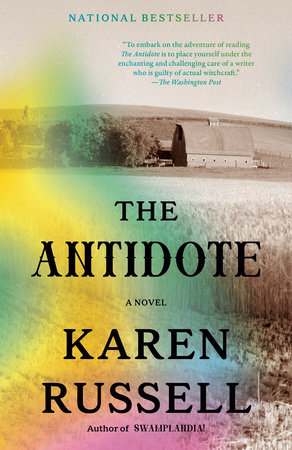
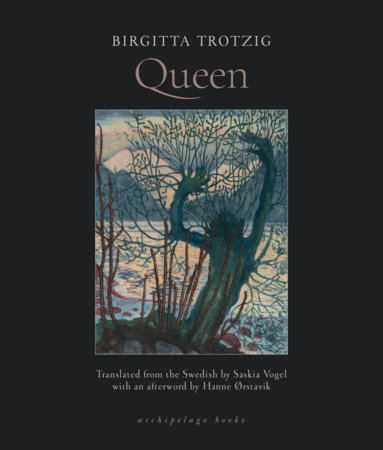
“It’s a distinct pleasure, reading a remarkable writer, largely untranslated into the English language, when there’s a robust back catalogue and new volumes waiting in the wings . . . Queen is rich with French existentialism and a more mystical divinity . . . Emerson wrote that ‘the maker of a sentence launches out into the infinite and builds a road into Chaos and Old Night.’ Reading Trotzig for the first time made me really feel this way; I was blissfully happy to follow her into the dark.”—Hannah Weber, Kismet
“Lives may seem to be sketched, given the brusqueness of the book, it’s shortness, yet here there is rich painting, layered and complex portraits of real-feeling, serious people.” —Triumph of the Now
“The narrative sweeps across landscapes, rural and urban alike, with an existential heaviness, leaving a tapestry woven of soil, sand, and sea, of lives, limbs, and longings. Time is unforgiving. Years pass. Decades pass. Losses seem to mount. Yet, Trotzig continually reminds us to place our trust in language.”—Joseph Schreiber, rough ghosts
“A strikingly poetic, persistently grim semi-fairy tale set at one of the edges of Europe: a strange, windswept shore where pregnant women fall through the ice, family farms are barricaded in the winter to keep out the destitute . . . The troubled characters that struggle through Queen are always close to incineration from within, tormented by their own lives . . . the perfect book to read in the dark, in the middle of winter, in the middle of a rainstorm.”—India Lewis, The Arts Desk
“Trotzig writes magnificently, monstrously . . . Queen, early on, poses a question: ‘Wintertime the sea speaks, what does a person have to add to that?’ It’s a challenge that Trotzig embraces, brewing a language at once sonorously laconic, a primal scream of stone and fire and water, and liable to erupt into surreal catechisms, fanged noumena, Tiresian curses. Hers is a twilight world. No resolutions, no reparations. Humanity as a plundered vessel. ‘I write to awaken and disturb,’ she later claimed. And how.” —Sukhdev Sandhu, 4Columns
“Transfixing . . . grandly cinematic in scope . . . Vogel’s translation soars.” —Cory Oldweiler, On the Seawall
“At the shimmering center of this book is the girl-woman named Judit, called Queen, whose eye contact the reader is made to seek as if entranced, be it given or avoided, dodged or desired. The sentences that describe Queen and her landscape are always two things at once: picture a child’s palm that holds two equally sized stones, worn smooth from the ocean or a tight fist, damp with seawater or sweat. Rubbing together within this book are beads of solitude and company, darkness and light, silence and utterance. Lethal and legendary, Trotzig’s world, in Vogel’s translation, is as definitive as the sun.” —Claire Foster, TYPE Books
“Queen is a remarkable novel: the reader may not relate to the characters, but they are so powerfully drawn that they linger long after the final page is turned. Trotzig’s ability to articulate the experience of a different time and place (this was a historical novel for her as well) is astonishing.” — 1st Reading
“Imagine, if you will, Kent Haruf via a prism of Jon Fosse and you’ll get an idea of what to expect from Queen. It’s both realistic and feverish, vividly recreating a hard scrabble life even as it occasionally zips and darts, caught up in its own lyricism . . . There is something live in this book (despite its having been written over 60 years ago), something that felt authentic and real, the proverbial mirror held up to nature . . . Trotzig does a marvellous job of retaining the reader’s sympathies.” — Bookmunch
“To me, Birgitta Trotzig is a giant. It’s such a rich and fascinating body of work. She’s Nobel-prize class. Reading Birgitta Trotzig is like walking into a dark cathedral. At first it’s just dark, but after a while the eyes adjust, and you begin to make out the colors.” –Eva Ström, Sveriges Radion/Sweden’s Radio
“It is difficult to overestimate the impact Birgitta Trotzig’s novels have had on Swedish literature. Her penetrating explorations of human condition and existence have left their mark on generations of authors and their writing. She never ceases to captivate. Her dystopian landscapes, darkening worlds and damaged human destinies always contain their opposite: vision, light, healing. But only as long as someone has the power to sow the seeds of restoration, in order to repair a broken world. Perhaps her books, and her fervent appeal, her seriousness, have never been as relevant as now. Our age of destruction, predation and authoritarian violence needs her.” –Hanna Nordenhök
“Birgitta Trotzig was the one who showed me how language can open itself out and embrace. I needed to soften up, I needed a softer language, and it was she who showed me it was possible… Language is both meaning and music, image and body. Something is held by this language. You can lean into it, as if the language itself were mother, as if the language itself were hands. To me it was trust, it seemed there was in Trotzig’s writing a trust of being itself, which I simply allowed to percolate in me, I read nearly everything she wrote, I doused myself in her language, which dared to lean, which holds, which gives.” —Hanne Ørstavik
“We are very dependent on language to have feelings at all. If you have an impoverished language, you have less emotion. And if you have less emotion, you understand less about your fellow human beings. Language and complex poetic language truly have a fantastic task: helping people to find themselves and to find out what they really are and really are experiencing. And that’s why I’m not afraid to write in a complex way because I know that there are people who can use these complex models in their own spiritual life. There aren’t that many, but they exist, and it is for them that I write.” –Birgitta Trotzig





 QUICK VIEW