

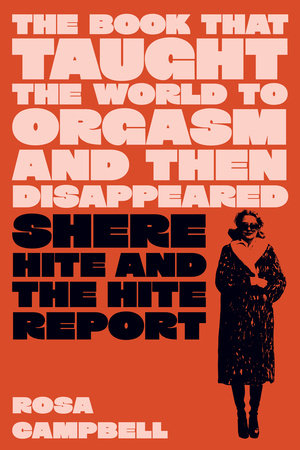
The Book That Taught the World to Orgasm and Then Disappeared Reader’s Guide
By Rosa Campbell



1. This book traces the history, legacy, and life of Shere Hite and her book The Hite Report. It is one of the most-read books of the 20th century and the 30th best-selling book of all time. Had you heard of it? Why do you think some prolific books and their authors seem to disappear? Can you think of other examples? Why do you think these have been wiped from public memory?
2. This book is written as a biography, though it tries to draw out ideas rather than tell the complete story of Shere Hite’s life. How did you find this? Was the balance between her personal history and the history of her work right for you? Do you read other biographies — why or why not? What do you like, or dislike, about the genre?
3. Chapter One discusses how Hite’s early life helped her understand sex as political — shaped by social structures beyond the bedroom. What does it mean to understand sex, usually thought of as a private matter between two individuals, as political, something impacted by power structures? Does this understanding make pleasurable sex more difficult? What does it open up? What does it shut down? Has your personal life shaped your understanding of sex, and if so, in what ways?
4. Many women who wrote to Shere described a specific sexual script: foreplay, intercourse, male orgasm. Where did this script come from? Why did women put up with it for so long? Have sexual expectations changed today — in what ways, and why or why not? Shere suggested that to change things up, women should become feminists and look to lesbians, who were having sex in a less scripted and much freer way. Who might we look to today?
5. Many women reported that the book made them feel “normal.” Why was this? What is normal sex today, compared to Shere’s time? Is the idea of “normal” sex or “normal” relationships always oppressive? Can it also be liberatory?
6. The book discusses Shere’s relationship to the women’s movement and feminism, and her use of the media. What is the role of celebrities in social movements? Do social movements need leaders? What are some of the pitfalls of working — or not working — collectively?
7. There are significant limits to Shere’s thinking, particularly in the area of race politics. What other limits did you notice? How do we discuss the blind spots of past thinkers in a way that feels satisfying and honest without dismissing all of their work? Do you think Shere was “cancelled”? Do you think she should have been? Is “cancel culture” a useful concept? Does it apply equally to the right and the left?
8. How do you feel about Shere Hite? Do you like her? Dislike her? What does she bring up for you — admiration, pity, anger? Are there feminists today who you think are similar to her? Who evokes strong feelings in you? The psychoanalyst Carl Jung proposed the concept of “the shadow self,” which suggests that people who provoke overwhelming negative feelings in us often reflect parts of ourselves we dislike and repress. What do you think of this idea?
9. The relationship of men to feminism was a hot topic for feminists. What do you think that relationship should be? Why do you think Shere was keen to include men in her project? Why do you think so many men read The Hite Report? Is feminism beneficial to men — and if so, in what ways? What about people of other marginalised genders who aren’t cis women, such as trans and non-binary people?
10. This book charts the story of the backlash against feminism through the story of Shere’s downfall. Do you think our times resemble that period? In what ways are they different? Are there different scapegoats today? Are backlashes inevitable? Research has found that times of economic hardship create a “zero-sum” sense in people — that marginalised people’s gains come at the expense of the “majority.” What can be done about this?