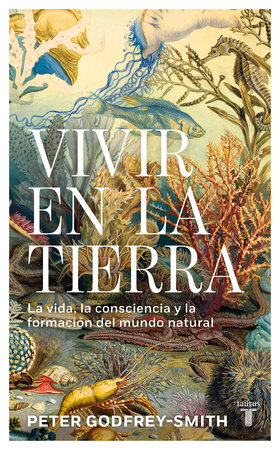
Vuelve el autor de Otras mentes con un ensayo fascinante y revelador sobre lo que une a todos los habitantes de la Tierra.
Si la historia de la Tierra se redujera a un año, nuestra especie surgiría en los últimos treinta minutos. Pero la vida ha existido durante 3.700 millones de años, la mayor parte de la historia de nuestro planeta y más de una cuarta parte de la edad del universo. ¿Qué hicieron esos organismos durante todo este tiempo?
Impulsado por esta cuestión, el filósofo y submarinista Peter Godfrey-Smith se pregunta en su nuevo libro cómo la vida fue moldeada y moldeó la Tierra, y nos invita a un fascinante recorrido por su historia. Visitaremos a gorilas ruandeses y pájaros australianos, bucearemos arrecifes de coral y guaridas de pulpos, consideraremos el impacto del lenguaje y la escritura para el planeta, y sopesaremos las responsabilidades que conllevan nuestros poderes únicos, en relación con la agricultura industrial, la conservación del hábitat, el cambio climático y el uso de animales en experimentos.
Desde los mares hasta los bosques, desde la primera aparición de la materia animada hasta su futura extinción, el autor nos ofrece una asombrosa visión del curso de la vida en la Tierra y de cómo podríamos afrontar los retos de nuestro tiempo. Los humanos pertenecemos a un sistema infinitamente complejo y nuestra mente es producto de ese sistema, pero también somos una fuerza capaz de modificar el mundo en el que vivimos. Somo criaturas de la Tierra, tenemos el futuro de la Tierra en nuestras manos.
ENGLISH DESCRIPTION
One of the Washington Post’s 50 Best Nonfiction Books of 2024
The bestselling author of Other Minds shows how we and our ancestors have reinvented our planet.
If the history of the Earth were compressed down to a year, our species would arise in the last thirty minutes or so of the final hour. But life itself is not such a late arrival: It has existed on Earth for something like 3.7 billion years―most of our planet’s history and over a quarter of the age of the universe (as far as we can tell).
What have these organisms―bacteria, animals, plants, and the rest―done in all this time? In Living on Earth, the philosopher Peter Godfrey-Smith proposes a new way of understanding how the actions of living beings have shaped our planet. Where his acclaimed books Other Minds and Metazoa explored the riddle of how conscious minds came to exist on Earth, Living on Earth turns to what happens when we look at the mind from another side―when we come to see organisms as active causes, not merely as results of the evolutionary process. The planet we inhabit is significantly the work of other living beings, who shaped the environments that we ourselves later transformed.
To that end, Godfrey-Smith takes us on a grand tour of the history of life on earth. He visits Rwandan gorillas and Australian bowerbirds, returns to coral reefs and octopus dens, considers the impact of language and writing, and weighs the responsibilities our unique powers bring with them, as they relate to factory farming, habitat preservation, climate change, and the use of animals in experiments. Ranging from the seas to the forests, and from animate matter’s first appearance to its future extinction, Godfrey-Smith offers a novel picture of the course of life on Earth and how we might meet the challenges of our time, the Anthropocene.






 QUICK VIEW