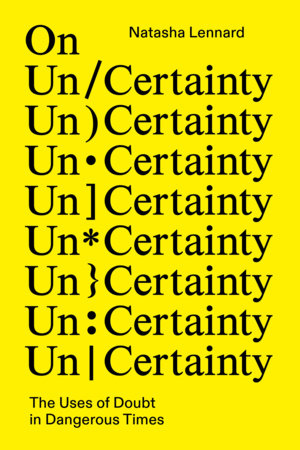
“An invitation to rethink what we know, and how we know it. Lennard challenges conventional understandings of crisis, borders and gender, revealing how deeply entrenched certainties shape our perceptions of the world.'”
—Naomi Klein, author of Doppelganger
“On Un/Certainty seeks to name and so unseat ‘pernicious certainty in action,’ and call for a different paradigm around the truths we take for granted–specifically as they pertain to what pundits are calling the polycrisis…Lennard’s got a knack for making the heady feel approachable, even to a layperson. This promises to be a most topical intervention for the thinking human. (Bonus: it’s slim enough to take on the subway.)”
—Most Anticipated Books of 2026, Lit Hub
“For penetrating and revolutionary insights, not only into “the news” per se but also into our hell-world’s basic epistemic workings and (especially) their impermanency, I always look to Natasha Lennard. At the same time as demonstrating almost every day—for well over a decade now—what a precious thing journalism can still be, Lennard has become this century’s most illuminating political reader of Wittgenstein and our most invigorating public philosopher of antifascism.”
—Sophie Lewis, author of Femmephilia
“We are snowed under by known unknowns. Thank heavens for Natasha Lennard then, here to talk us through the expectations we place on words and walk us out of the numbness induced by their mindless repetition.”
—Quinn Slobodian, author of Hayek’s Bastards
“Sometimes an essay arrives that sends a gust of fresh air into the stuffy present from an unexpected angle. What does it mean when people say they feel assailed by uncertainty and insecurity? A sign hovering over a conjuncture of seemingly ubiquitous instability, this trope has never been investigated – until now. Making surprising use of Wittgenstein, Natasha Lennard here enjoins us to think anew, and closer, about the meanings of uncertainty on the fronts – racism, transphobia, genocide – that define our age. Hers is a vital contribution to the hard work of making any sense of what’s going on.”
—Andreas Malm, author of How to Blow Up A Pipeline
“Fascism attempts to destroy the capacity to think. Natasha Lennard restores it here with lyric philosophy.”
—Hannah Zeavin, Associate Professor of History, UC Berkeley
“Amidst inflationary talk of uncertainty and crisis, Lennard makes a bracing case, instead, for the critique of pernicious certainties. A brilliant provocation to further thought. A hinge book.”
—Adam Tooze, author of Shutdown
“While doubt and uncertainty can be fear-inducing, the entrenched certainties on which society rests are far more dangerous, according to this stimulating treatise from journalist Lennard…Her energetic challenges to the status quo are timely and intellectually robust. This is sure to spark conversation.”
—Publishers Weekly
“I can think of no better guide to the perplexing present than the brilliant Natasha Lennard. This luminous book, unflinching in its moral clarity, upends conventional thinking about thinking itself, and emboldens its lucky readers to question and resist today’s most pernicious shibboleths and lethal certainties”
—Astra Taylor, author of Democracy May Not Exist, but We’ll Miss It When It’s Gone