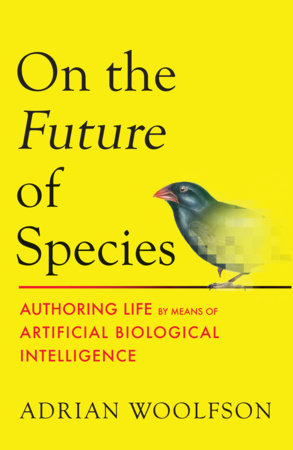
“A lucid, thoughtful, at times troubling review of a new era in biology.” —Kirkus
“A sweeping account of the history and science behind this transformational technology” —Kate Adamala, Nature
“Raises some of the most challenging philosophical and ethical issues that humankind has ever had to address” ―Ben Spencer, The Sunday Times
“On the Future of Species…offers a lucid and occasionally unsettling account of an under-appreciated technological revolution that will affect us all, allowing humanity to attempt what Darwin believed only nature could accomplish: to write the next chapter of life.” —The Financial Times
“An intriguing and disturbing analysis of a biological revolution … Compelling, clear and straightforward” ―Robin McKie, The Guardian
“A pocket guidebook for the public to comprehend a future where biology becomes infrastructure” ―Chris Stokel-Walker, The Standard
“Fascinatingly scary stuff to huddle under the duvet with” ―Liz Else, New Scientist
“Considers the ungodly convergence of AI and synthetic biology” ―Ian Thomson, The New Statesman
“An intriguing tale…It contains much that is fascinating, enticing, and usefully provocative.” ―Philip Ball, The Lancet
“Essential reading” ―The Tribune
Endorsements
“A visionary and exhilarating exploration of biology’s next great frontier. Adrian Woolfson has written a work of astonishing scope and imagination, charting the convergence of artificial intelligence and genome synthesis. He takes readers from the foundations of molecular genetics to the threshold of a world in which we may author entirely new species, whilst reimagining human health. Bold, lucid, and deeply original, On the Future of Species is essential reading for anyone interested in the destiny of life on Earth and beyond.”
—Tim Coulson, author of A Little History of Everything From the Big Bang to You
“The book we need right now: a clear-eyed, comprehensive look at how AI, gene editing, and synthetic biology are converging to give humanity unprecedented power over its own evolution. Part history, part forecast, entirely compelling. Woolfson guides us through the landmarks of molecular biology with the assurance of an expert and the enthusiasm of a born storyteller. He brings a rare combination of industry experience and literary skill to one of the most consequential questions of our time. Essential reading for anyone seeking to understand where genomic technologies are taking us.”
—Tom Ellis, Professor of Synthetic Genome Engineering, Imperial College London
“A brilliantly crafted, sweeping exposition with profound insights essential for any citizen of the twenty-first century.”
—Tim White, Professor of Integrative Biology, University of California, Berkeley
“Darwin wrote The Origin of Species in 1859. With the emergence of large language of life models—artificial biological intelligence—it was the right time to envision On the Future of Species. Woolfson delivers that in this brilliant book, a very thoughtful and thorough assessment of the profound implications of editing and rewriting our code.”
—Eric Topol, founder of Scripps Research Institute and author of Super Agers
“Scientists already know how to read the language of DNA and to edit it. Woolfson details the new frontier—writing new DNA scripts from scratch.”
—Thomas R. Cech, Nobel Prize winner and author of The Catalyst
“A terrific read that will be interesting to a very broad audience. I particularly enjoyed the blend of engagingly narrated scientific history with forecasting the future. Adrian is absolutely correct that we are embarking on a new era in which humankind will be able to create completely new kinds of biology that evolution has never explored. This is both tremendously exciting and rather scary.”
—Patrick Maxwell, Regius Professor of Physics and Head of the School of Clinical Medicine, University of Cambridge
“A fascinating read exploring the principles of biology applied to medicine from a different lens.. I thoroughly recommend it for all audiences, from students to healthcare professionals of all backgrounds.”
—Professor Mumtaz Patel, President of the Royal College of Physicians
“In On the Future of Species, Adrian Woolfson explores the profound opportunities and challenges that arise when we turn evolution upside down – beginning not with random mutation but with deliberate selection. Woolfson’s book prepares readers for the scientific, moral and societal dilemmas that will accompany such a transformation and concludes by outlining a framework – a scaffold for a manifesto – that humanity will need to deliberate as synthetic biology evolves.’
—John-Arne Rottingen, CEO of the Wellcome Trust
“A dazzling and prescient dive into the future of species, Woolfson explores the emergence of Artificial Biological Intelligence, capable of unravelling the genome’s regulatory code. Our genomes … and those of all creatures … are riddled with “spaghetti code” hopelessly convoluted by accidents of evolutionary history, demanding an ABI approach that unlocks a brave new world of biological possibility.”
—Jef Boeke, Founding Director of the Institute for Systems Biology at NYU Langone Medical Center and Leader of the Sc2.0 Synthetic Yeast Genome International Consortium.
“Woolfson explores the question that many biologists are asking but few can answer: where will AI-supercharged bioscience lead us? It authoritatively defines what a ‘post-Darwinian’ future could and should look like. A hopeful guide to the ‘Brave New World’ of AI-powered bioscience.”
—Tom Ireland, editor of The Biologist and author of The Good Virus
“The past two centuries have seen two profound shifts in our understanding of evolutionary biology – the C19th realisation that evolution exists and the gradual unpicking through the C20th and C21st of the genomic mechanisms that control the development of living organisms. Adrian Woolfson set out in this book the fascinating notion that we could one day – perhaps quite soon – see a third revolution in which we directly tap into this genetic code to author entirely new biological species. The implications are profound, and I thoroughly encourage anyone with an interest in the natural world to read this important book.”
—Doug Gurr, Director of the Natural History Museum, London
“Every great leap in human progress begins with a new way of seeing. For centuries, we’ve viewed biology as something to be studied. Adrian Woolfson wants us to see it as something to be authored. With AI as our collaborator, we are learning to speak the language of life itself — and in doing so, to design the future of our species. This book shows us the next frontier, where the code of life meets the code of machines, and foresight becomes the most essential human trait.”
—Amy Webb, bestselling author of The Big Nine and The Genesis Machine
“Woolfson’s The Future of Species offers a lucid and prescient account of the transition from natural evolution to intentional genome design. As synthetic genomics moves from editing to whole-genome rewriting, this book provides an indispensable guide to the possibilities, responsibilities, and profound choices ahead. 未来的生命 = 生命的未来!”
—Patrick Yizhi Cai, Chair Professor of Synthetic Genomics, The University of Manchester & International coordinator of Sc2.0 consortium
“Woofson’s lucid prose describes fascinating details about the hundreds of scientists whose work allows us to speed-read genomes now, and to write genomes soon. Life on Earth will, literally, never be the same. What will new designer species do for us, and to us? This book provides essential background for urgently needed deep discussions.”
—Randolph M. Nesse, Founding Director of the Center for Evolution and Medicine at Arizona State University, Author of Why We Get Sick: The New Science of Darwinian Medicine
“On the Future of Species explains how we got to understand the chemistry of life, setting the scene for a mind-blowing exploration of the opportunities opened up by this understanding for tackling diseases and possibly improving the human body. But at the same time, it offers wise counsel about the dangers involved in such tinkering and points up the need for regulation. It is both timely and authoritative, and deserves to be widely read.”
—John Gribbin, author of Science: A History, In Search of the Multiverse, and Six Impossible Things
“Adrian Woolfson has written a forward-looking, detailed history about the developments in the new field of synthetic biology, whereby rewriting the genetic code, biological functions can be added or removed from cells and organisms, and entirely new species created. This history leads to the conclusion that the future of humanity includes or depends on the editing and rewriting of the human genetic code. Importantly, Woolfson discusses key ethical steps that society must agree on to move forward. The book is well-timed to help stimulate discussion, as we move into CRISPR editing of human genes and some reckless attempts at human cloning.”
—J. Craig Venter, Ph.D., Founder and CEO of the J. Craig Venter Institute and leader of the teams that first sequenced the human genome and made the first synthetic genome and species
“In On the Origin of Species, Charles Darwin presented artificial selection as a “magician’s wand,” enabling expert human breeders to conjure into existence whatever new living forms they desired. According to Adrian Woolfson, a vastly more powerful successor now in the works is artificial biological intelligence: the AI-guided synthesis of genomes, for purposes ranging from the curing of illness to the creation of new species. On the Future of Species is at once a history of these remarkable developments, a report from the scientific and technological frontlines, and an attempt to chart a path through the morally complex territory ahead. A fascinating and important book.”
—Gregory Radick, author of Disputed Inheritance: The Battle over Mendel and the Future of Biology
“Every great leap in human progress begins with a new way of seeing. For centuries, we’ve viewed biology as something to be studied. Adrian Woolfson wants us to see it as something to be authored. With AI as our collaborator, we are learning to speak the language of life itself — and in doing so, to design the future of our species. This book shows us the next frontier, where the code of life meets the code of machines, and foresight becomes the most essential human trait.”
—Amy Webb, bestselling author of The Big Nine and The Genesis Machine
“Woolfson’s The Future of Species offers a lucid and prescient account of the transition from natural evolution to intentional genome design. As synthetic genomics moves from editing to whole-genome rewriting, this book provides an indispensable guide to the possibilities, responsibilities, and profound choices ahead. 未来的生命 = 生命的未来!”
—Patrick Yizhi Cai, Chair Professor of Synthetic Genomics, The University of Manchester & International coordinator of Sc2.0 consortium
“Woofson’s lucid prose describes fascinating details about the hundreds of scientists whose work allows us to speed-read genomes now, and to write genomes soon. Life on Earth will, literally, never be the same. What will new designer species do for us, and to us? This book provides essential background for urgently needed deep discussions.”
—Randolph M. Nesse, Founding Director of the Center for Evolution and Medicine at Arizona State University, Author of Why We Get Sick: The New Science of Darwinian Medicine
“On the Future of Species explains how we got to understand the chemistry of life, setting the scene for a mind-blowing exploration of the opportunities opened up by this understanding for tackling diseases and possibly improving the human body. But at the same time, it offers wise counsel about the dangers involved in such tinkering and points up the need for regulation. It is both timely and authoritative, and deserves to be widely read.”
—John Gribbin, author of Science: A History, In Search of the Multiverse, and Six Impossible Things
“Adrian Woolfson has written a forward-looking, detailed history about the developments in the new field of synthetic biology, whereby rewriting the genetic code, biological functions can be added or removed from cells and organisms, and entirely new species created. This history leads to the conclusion that the future of humanity includes or depends on the editing and rewriting of the human genetic code. Importantly, Woolfson discusses key ethical steps that society must agree on to move forward. The book is well-timed to help stimulate discussion, as we move into CRISPR editing of human genes and some reckless attempts at human cloning.”
—J. Craig Venter, Ph.D., Founder and CEO of the J. Craig Venter Institute and leader of the teams that first sequenced the human genome and made the first synthetic genome and species
“In On the Origin of Species, Charles Darwin presented artificial selection as a “magician’s wand,” enabling expert human breeders to conjure into existence whatever new living forms they desired. According to Adrian Woolfson, a vastly more powerful successor now in the works is artificial biological intelligence: the AI-guided synthesis of genomes, for purposes ranging from the curing of illness to the creation of new species. On the Future of Species is at once a history of these remarkable developments, a report from the scientific and technological frontlines, and an attempt to chart a path through the morally complex territory ahead. A fascinating and important book.”
—Gregory Radick, author of Disputed Inheritance: The Battle over Mendel and the Future of Biology






 QUICK VIEW