

Best Seller
Paperback
$16.99
Available on Aug 18, 2026 | 304 Pages
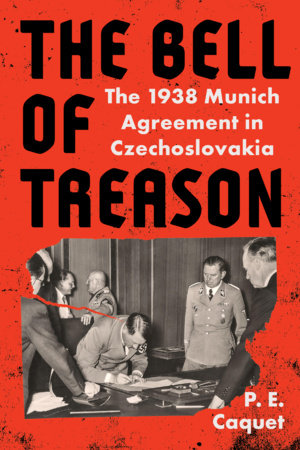
Drawing on a wealth of previously unexamined material, this staggering account sheds new light on the Allies’ responsibility for a landmark agreement that had catastrophic consequences.
On returning from Germany on September 30, 1938, after signing an agreement with Hitler on the carve-up of Czechoslovakia, Neville Chamberlain addressed the British crowds: “My good friends…I believe it is peace for our time. We thank you from the bottom of our hearts. Go home and get a nice quiet sleep.” Winston Churchill rejoined: “You have chosen dishonor and you will have war.”
P. E. Caquet’s history of the events leading to the Munich Agreement and its aftermath is told for the first time from the point of view of the peoples of Czechoslovakia. Basing his work on previously unexamined sources, including press, memoirs, private journals, army plans, cabinet records, and radio, Caquet presents one of the most shameful episodes in modern European history. Among his most explosive revelations is the strength of the French and Czechoslovak forces before Munich; Germany’s dominance turns out to have been an illusion. The case for appeasement never existed.
This nail-biting story of diplomatic intrigue is perhaps the nearest thing to a morality play that history ever furnishes. The Czechoslovak authorities were Cassandras in their own country, the only ones who could see Hitler’s threat for what it was. In Caquet’s devastating account, their doomed struggle against extinction and the complacency of their notional allies finally gets the memorial it deserves.
On returning from Germany on September 30, 1938, after signing an agreement with Hitler on the carve-up of Czechoslovakia, Neville Chamberlain addressed the British crowds: “My good friends…I believe it is peace for our time. We thank you from the bottom of our hearts. Go home and get a nice quiet sleep.” Winston Churchill rejoined: “You have chosen dishonor and you will have war.”
P. E. Caquet’s history of the events leading to the Munich Agreement and its aftermath is told for the first time from the point of view of the peoples of Czechoslovakia. Basing his work on previously unexamined sources, including press, memoirs, private journals, army plans, cabinet records, and radio, Caquet presents one of the most shameful episodes in modern European history. Among his most explosive revelations is the strength of the French and Czechoslovak forces before Munich; Germany’s dominance turns out to have been an illusion. The case for appeasement never existed.
This nail-biting story of diplomatic intrigue is perhaps the nearest thing to a morality play that history ever furnishes. The Czechoslovak authorities were Cassandras in their own country, the only ones who could see Hitler’s threat for what it was. In Caquet’s devastating account, their doomed struggle against extinction and the complacency of their notional allies finally gets the memorial it deserves.
Author
P.E. Caquet
P. E. Caquet is a senior member of Hughes Hall, Cambridge. His PhD was published as The Orient, the Liberal Movement, and the Eastern Crisis of 1839–41, and his other books include The Invention of Realpolitik, 1848–1871 and Opium’s Orphans: The 200-Year History of the War on Drugs. Before studying as a historian at Cambridge, he lived for ten years in Prague. He is fluent in Czech, Slovak, French, and German.
Learn More about P.E. CaquetYou May Also Like
Bombing Hitler’s Hometown
Trade Paperback
$18.95
Stay Alive
Hardcover
$35.00
American Flygirl
Trade Paperback
$18.95
G.I. G-Men
Hardcover
$29.00
Chamber Divers
Trade Paperback
$27.00
The Remarkable Life of Reed Peggram
Hardcover
$30.00
Partisan Song
Hardcover
$29.00
Fighting the Night
Trade Paperback
$21.00
Advance Britannia
Hardcover
$40.00
×
