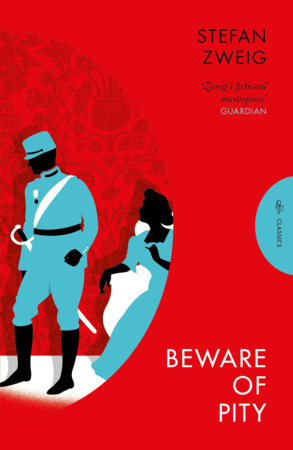
Stefan Zweig’s tragic novel of guilt, yearning, and the danger of pity, which inspired Wes Anderson’s The Grand Budapest Hotel.
“Original and powerful.” —The New York Times
The only novel Zweig—one of the most popular authors of the 20th century—completed and published during his lifetime, Beware of Pity is a heartrending tale of unequal affection, unintended consequences, and a world falling to pieces.
In 1913, young second lieutenant Hofmiller discovers the terrible danger of pity. Stationed at the edge of the Austro-Hungarian Empire, he is invited to a party by a rich local landowner, who also happens to have a pretty daughter. But when Hofmiller asks the girl to dance he unleashes a fatal chain of consequences. He had no idea she was lame, and finds himself in an agony of shamed embarrassment. So begins a series of visits, motivated by pity, which relieves his guilt but gives her a dangerous glimmer of hope.
Stefan Zweig’s only full-length novel has inspired multiple stage adaptations and was the starting point for Wes Anderson’s film The Grand Budapest Hotel. Unfolding in a breathless sweep from Hofmiller’s initial mistake, it displays at full length all the psychological insight and emotional intensity known to readers of Zweig’s bestselling novellas.
A century after it was first written, Beware of Pity remains a devastating depiction of the betrayal of both honour and love, realised against the background of the disintegration of the Austro-Hungarian Empire and the beginnings of the First World War.







 QUICK VIEW