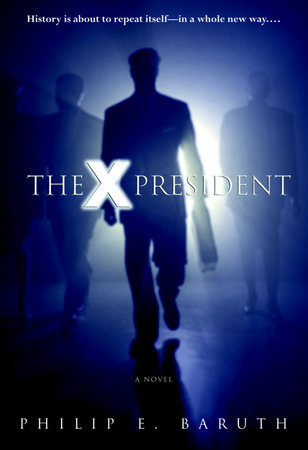
Editor’s Note: The following conversation with author Philip Baruth took place in Burlington, Vermont, the first week of September, 2003. We met in a coffee shop near the Howard Dean for President Campaign office. Dean — a hometown favorite in Burlington — was currently surging in the polls, and more than once I could faintly make out cheers from the campaign’s headquarters. It seemed an auspicious time to sit down for a serious discussion with another hometown boy in the process of releasing what may be one of the strangest novels about the modern American presidency ever written.
INTERVIEWER: There’s that cheering again. Is it always like this?
PHILIP BARUTH: Pretty much. A lot of people in Vermont really don’t like where the country’s been headed the last two or three years. [Faint cheering crescendoes]
INT: Right. Well, to start, I wanted to ask you about a line from one of the reviews of The X President. Kirkus said that it was [Fumbles with folder, comes up with review], they said it was a hybrid. I’ll quote it: “a time-travel extravaganza that’s also a political novel featuring Bill Clinton.” So first question — which is it really?
PB: Well, here’s the way I see it. The novel is a political satire on Bill Clinton, but also on the people who’ve been running the country since he left office. And it uses time-travel, science fiction elements — and additionally a bit of the thriller genre — as a vehicle to forward that satire.
INT: So it’s mostly political satire.
PB: It’s just hard to separate it out that way. Let me try this. I read and re-read a lot of books while I was writing this novel, but two books were really central, two of the most fascinating books written in the last twenty years: David Maraniss’s First in His Class, still the best biography about Bill Clinton, and Snow Crash, by Neal Stephenson. If you’ve never read it, First in His Class deals with Clinton’s early years — it ends with his campaign kick-off in 1991. That keeps the focus on the young Clinton, the formative events, the weird combination of talent and upbringing and social change that lands him in the White House. And Stephenson’s cyberpunk, when I read it in the early 90’s, changed the way I was thinking about shaping a story. Snow Crash rolls like a freight train, short cliffhanger chapters, never letting up, even as it flashes by enticing little bits of future history and an impressive amount of information about computers, language, viruses and ancient Sumerian culture. So that’s how I wanted to handle the wealth of political information I had about Clinton: I wanted the narrative to pump along, never letting up, even as fairly detailed political scenarios scrolled past. And the time travel would allow me to create exaggerated versions of Clinton, a really young version and a really old version, as a way of fleshing out the character of the middle-aged Clinton all of us think we know. That three-tiered character of Clinton is the part I worked the hardest trying to get right.
INT: I’m curious, I guess, about why you would write such a thing. A book featuring a sixteen-year-old Bill Clinton and a one-hundred-and-nine-year-old Bill Clinton.
PB: I don’t know [Head in his hands, in mock-despair]. You’re not the only one asking me that question. I feel like I’m in the backroom at the stationhouse and I’ve just murdered a guy and the cops are screaming, “Why’d you do it, killer?!” What can you say? It all happened so fast? It seemed like a good idea at the time?
Actually, I think the answer is fairly straightforward. The first three presidential elections I voted in, I was on the losing side. And life on the losing side during the Reagan/Bush years was not fun. Then, in 1992, I voted for a winner. I remember being at a party on election night with a bunch of other people who’d never voted for a winner, and we didn’t even know what to do when Clinton went over the top. We had no practice with champagne bottles, for instance. A cork? What the heck is that?
But one thing I did do was to begin reading voraciously about Clinton, trying to figure out what made him different, what made him tick. I think I’ve read probably a hundred books on the guy, at this point. At a certain point, you have to do something with all of that information.
INT: What keeps the Clinton-character in the book alive for so many years?
PB: He’s preserved by regret. That and advances in geriatric technology, and a kind of smoldering desire to replay the eight years of his presidency.
INT: Other than BC, who’s your favorite character?
PB: The time-traveling James Carville. I think he’s the coldest, funniest, most manipulative character I’ve ever written. There’s also another character who’s like an evil British Newt Gingrich that I get a kick out of.
INT: I think we have time for one more [Consults question sheet]. In the background of your book is a thirty-year set of global conflicts called The Cigarette Wars. It’s something like World War III, touched off by the expansion of NATO, and aggressive tobacco sales in the Third World. How much of a parallel should I draw between that and the real-world geopolitics?
PB: Well, there are some connections. The Cigarette Wars are produced by greedy tobacco companies, backed by successive administrations pushing highly aggressive, unilateralist foreign policy. Their sense of things is that the US is the sole remaining superpower, end of story. But in my book the rest of the countries of the world eventually put their heads together, and before you know it the US is looking at an actual invasion of the American mainland. In 2055, they’re left with only one option — Sal and her team of time-traveling secret operatives. It’s a Hail Mary pass. Sometimes when the powerful people are taking the world to hell in a handbasket, that’s really the best you can do — put your nickel on a little longshot with a good heart. And in a tiny state like Vermont, believe me, we know longshots. [More cheers float out of the Dean for President Headquarters] You know what I’m saying?






 QUICK VIEW