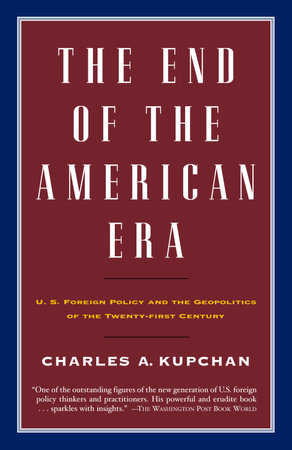
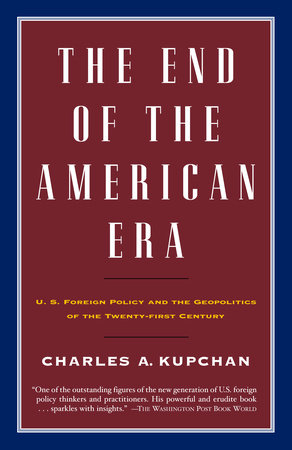
A Conversation with Charlie Kupchan
author of THE END OF THE AMERICAN ERA: Us Foreign Policy and the Geopolitics of the Twenty-first Century
Q: Most observers believe that the United States is at the peak of its power and in the midst of a new imperial moment. You contend that U.S. primacy is already diminishing. Why the difference in perspective?
A: The United States will remain at the top of the pecking order for the foreseeable future, especially in the military arena. But a more collective and self-confident Europe is emerging as a political counterweight to Washington. As the EU continues its rise, the transatlantic rivalry that has already begun will inevitably intensify; centers of power by their nature compete for position, influence, and prestige. China’s rise is further off, but its gradual ascent will also offset U.S. preponderance. A world dominated by America is poised to give way to one of multiple centers of power, making the global landscape more difficult to manage.
Q: Europe seems to be preoccupied with its own agenda and rarely able to speak with a single voice. Why do you see the EU as the next challenger to America?
A: Politics that take shape by stitching together previously separate states always emerge tentatively. Keep in mind that America’s own amalgamation during the nineteenth century occurred slowly and haltingly — and was punctuated by a civil war. The EU is far from being a unitary federation, but its wealth rivals America’s and its members are strengthening a collective conscious and forging a clearer sense of interests and values that are quite distinct from those of the United States. Within the past year alone, the EU has had deep disagreements with the U.S. on a long list of key issues, including the war against terrorism, the Middle East peace process, the Kyoto Protocol on global warming, and the International Criminal Court. As the EU fortifies its governmental institutions and takes in new members, it will become a formidable counterweight to the United States on the world stage.
Q: You also argue that the waning of U.S. primacy will to some extent be of America’s own doing. Please explain.
A: Yes, America’s own politics will constrain the country’s engagement in the world. During most of its history, the U.S. embraced a contentious and contingent brand of internationalism. This ambivalence toward international engagement is making a comeback. So is the country’s longstanding aversion to compromising its sovereignty by submitting to the will of international institutions. The multilateral brand of internationalism in place since World War II is thus falling prey to unilateralist and neo-isolationist alternatives that have deep roots in American politics and history.
Q: Why is American internationalism changing so dramatically?
A: Many forces are at work. In the absence of a major adversary like the Soviet Union, the country’s willingness to play the role of global guardian has been diminishing. Younger Americans who lived through neither World War II nor the Cold War are rising to positions of prominence; they will not bring to the table the key historical memories that shaped U.S. foreign policy for decades. Cultural and political divides among America’s regions and the country’s are rising. Hispanic population are also increasing the difficulty of forging a common internationalism.
Q: But didn’t the terror attacks of September 11 shore up U.S. internationalism and rebuild
enthusiasm for multilateralism and full engagement in global affairs?
A: The popular comparison to Pearl Harbor is misleading. Terrorism poses a shadowy and elusive threat that promises to reinforce the drift to unilateralism and neo-isolationism. Even as the United States tracks down and seeks to destroy terrorists and their sponsors it will also seek to cordon itself off from threats and raise protective barriers. In light of its elusive nature, the threat of terrorism also provides a shaky foundation for engaging the American public and rebuilding a steady internationalism.
Q: What is your assessment of how the Bush administration has conducted the struggle against terrorism?
A: At the tactical level, the Bush team has done a good job of prosecuting the war against Al-Qaeda and degrading its ability to carry out further attacks. The Bush administration has also succeeded in advancing non-military efforts to neutralize terrorist threats, such as enhancing intelligence capabilities, strengthening international cooperation among law enforcement agencies, and improving capacities for tracing financial flows. At the strategic level, however, the record is less impressive. The Bush administration has exaggerated the extent to which the threat of terror opens a new era and redefines the international landscape. It is focusing on terrorism to the exclusion of almost all other domestic and foreign issues. Perhaps the main danger ahead is that U.S. policy makers will continue to believe that the world has changed more than it has, holding a view of the international system that bears little resemblance to that envisaged by the rest of the world.
Q: What are the implications of your analysis for U.S. policy toward Iraq?
A: The United States needs to maintain a vigilant posture toward terrorist groups and toward rogue states that possess weapons of mass destruction. Washington should not, however, act on its own, but instead work through the United Nations and in coordination with like-minded allies. Otherwise, the United States may succeed in destroying Al-Qaeda and toppling Saddam Hussein, but at the expense of the alliances and institutions that remain the bedrock of
international peace and prosperity.
Q: Many scholars and policy makers have embraced the idea, popularized by Francis Fukuyama, that the spread of democracy is bringing history to a happy and peaceful end. You foresee the opposite — the rebirth of history. Please explain.
A: I believe that history moves forward at the same time that it cycles. As the industrial age gives way to the digital age, one phase of history is closing, but another is opening. It is too early to envisage the key characteristics of the digital era, but it promises to have a profound impact on the main political and social institutions of the industrial era — republican democracy and nationalism. Accordingly, I am wary of putting any degree of confidence in the proposition that history is coming to a peaceful end. Rather, we are entering a phase of epochal change.
Q: Do you see indications that the onset of the digital age is already having an impact on America?
A: It is too early to draw a direct causal link between the digital age and the signs of stress now showing in American democracy. Nonetheless, the rise of the digital economy, by reversing the ethnic melting pot of the industrial era, crowding out deliberative time, and increasing social isolation appears to be taking a toll on America’s institutions, giving the country’s political system its sluggish feel. The emerging trends — declining civic engagement and social capital, political polarization, corporate excesses — are consistent with the notion that America’s institutions are growing brittle and unresponsive in the face of the social changes accompanying the transition from an industrial to a digital economy.





 QUICK VIEW