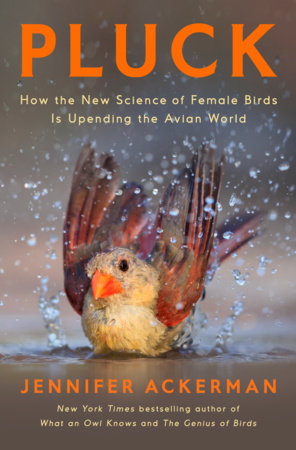


Recent studies about female birds upend everything we thought we knew about birds. Until now, research focused almost exclusively on the male half of the class. But female Northern Cardinals learn their songs three times faster. Female House Wrens can be even more aggressive. Female birds in general also often have entirely different migratory patterns and are quicker to adapt to climate change. They talk to their young when they are still in the egg and even chirp “passwords” to their nestlings that signify safety.
Jennifer Ackerman has been writing about birds for over twenty years and grew up with the conventional wisdom found in field guides and bird books. According to them, females were drab and passive. They didn’t sing. They were good mothers, sitting faithfully on their eggs, tending and feeding their young. Nothing could be further from the truth. From ice-filled New Hampshire lakes to the deep recesses of the Amazonian jungles, female birds are both more like males than we thought—capable of typical male behaviors like aggression, competition, complex song, and sexual assertiveness—and less like them, with radically different ways of living and surviving than their male counterparts, wildly different skills, opportunities, and risks.
Why have we gotten things so wrong? What has held science back on the female front? It is important that we find out, for as Ackerman writes, “conservation planning has long been aimed at protecting male-dominated habitats.” Some female birds have lost almost twice as much ground as the males over the past few decades. Bird lovers will receive no better gift than this extraordinary chance to fly higher and further than was ever possible before, to see all birds, and then save them, too.
Author
Jennifer Ackerman
Jennifer Ackerman has been writing about science and nature for more than three decades. Her most recent book, What an Owl Knows: The New Science of the World’s Most Enigmatic Birds, explores recent findings on the biology, behavior, and conservation of owls. A bestseller, it was selected as a best book of 2023 by The New York Times, The Economist, The Times (UK), and NPR’s Science Friday. Her previous book, The Bird Way: A New Look at How Birds Talk, Work, Play, Parent, and Think, was a finalist for the PEN/E. O. Wilson Literary Science Writing Award. Her New York Times bestselling book, The Genius of Birds, has been translated into twenty-eight languages and was named one of the best nonfiction books of 2016 by The Wall Street Journal, a Best Science Book by NPR’s Science Friday, and a Nature Book of the Year by The Sunday Times. Her other books include Birds by the Shore: Observing the Natural Life of the Atlantic Coast, Sex Sleep Eat Drink Dream: A Day in the Life of Your Body, and Chance in the House of Fate: A Natural History of Heredity. Ackerman’s articles and essays have appeared in National Geographic, The New York Times Magazine, Scientific American, and many other publications. She is the recipient of numerous awards and fellowships, including a 2024 Guggenheim Fellowship, fellowships from the National Endowment for the Arts and the Bunting Institute, and a grant from the Alfred P. Sloan Foundation.
Learn More about Jennifer Ackerman