More urgent than ever, 3 landmark essays offer a stark warning about the fragility of democracy and the need to think for ourselves.
With an introduction by an acclaimed Arendt scholar, here is a compact introduction to Arendt’s larger thinking about the specter of totalitarian rule
In an era of deep political polarization and digital disinformation, as we find ourselves increasingly isolated from others, the insights of Hannah Arendt have never been more relevant. Bringing together three of Arendt’s most important essays, this essential volume offers a clarifying picture of how totalitarianism takes root in the modern soul.
Writing in the immediate aftermath of World War II, Arendt was not merely a witness to history; she was attempting to understand a terrifying new phenomenon that defied all traditional categories of political science and morality. In “Understanding and Politics” she explores the heavy burden of coming to terms with a world that has been shattered. In “On the Nature of Totalitarianism,” she dismantles the idea that totalitarianism is a modern version of tyranny or authoritarianism, revealing instead a radical new form of government that seeks to abolish human spontaneity itself. And in “Ideology and Terror,” Arendt lays bare the psychological machinery of oppression. She demonstrates how ideologies replace the complexity of reality with a single, unwavering narrative, and how the pervasive experience of loneliness and social isolation creates the perfect soil for total domination to flourish.
The volume serves as a stark warning that the loss of a shared world and the erosion of truth are the first steps toward the abyss. For citizens, students, and thinkers alike, this volume is an indispensable work about the fragile boundaries of democracy and the need for the freedom to think for ourselves.
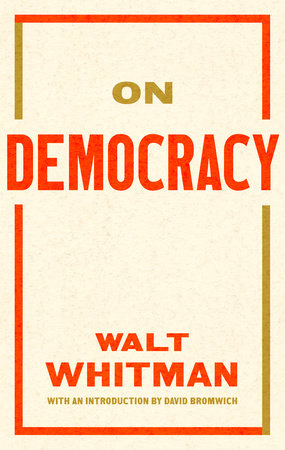
Gathered together for the first time, Walt Whitman’s urgently needed prose writings on the democratic spirit and the soul of the nation.
12 short works encapsulate the American Bard’s fiery passions and timeless wisdom for today.
Here for the first time in a convenient pocket edition are all of Walt Whitman’s essential prose writings on democracy, including his unforgettable reflections on the roots on American division, the fearful legacy of the Civil War, and shining example of Abraham Lincoln. Few writers have been as harsh in their condemnation of America’s sins and spiritual shortcomings or as abiding in his faith in democratic ideals as Whitman. His clarion voice speaks to us with renewed urgency today.
Gathered here are: “The Eighteenth Presidency!,” written during the 1856 presidential campaign, in which Whitman expresses his rage over the immediate prospects for American democracyDemocratic Vistas (1871), in which he dramatizes his role as poet-prophet of a better Americathe searing essay “Origins of Attempted Secession” and shorter extracts on democracy from the classic book Specimen Days (1882). In his introduction, acclaimed political observer David Bromwich examines Whitman’s political prose writings and highlights why they matter today.
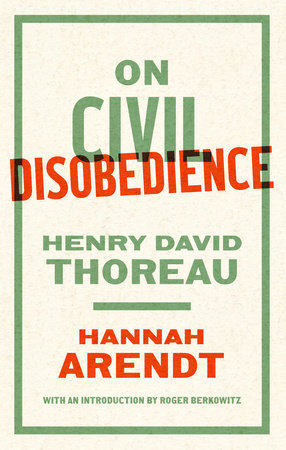
More urgent than ever: as we grapple with how to respond to emerging threats against democracy, Library of America brings together two seminal essays about the duties of citizenship and the imperatives of conscience
Together for the first time, classic essays on how and when to disobey the government from two of the greatest thinkers in our literature.
In “Resistance to Civil Government” (1849), Henry David Thoreau recounts the story of a night he spent in jail for refusing to pay poll taxes, which he believed supported the Mexican American War and the expansion of slavery. His larger aim was to articulate a view of individual conscience as a force in American politics. No writer has made a more persuasive case for obedience to a “higher law.”
In “Civil Disobedience” (1970), Hannah Arendt offers a stern rebuttal to Thoreau. For Arendt, Thoreau stands in willful opposition to the public and collective spirit that defines civil disobedience. Only through positive collective action and the promises we make to each other in a civil society can meaningful change occur.
This deluxe paperback features an introduction by Roger Berkowitz, Founder and Academic Director of the Hannah Arendt Center for Politics and Humanities and Professor of Politics, Philosophy, and Human Rights at Bard College, who reflects on the tradition of civil disobedience and the future of American politics.
More urgent than ever, two landmark essays by the legendary political theorist on the greatest threat to democracy, gathered with a new introduction by David Bromwich
“No one,” Hannah Arendt observed, “has ever counted truthfulness as a political virtue.” But why do politicians lie? What is the relationship between political lies and self-delusion? And how much organized deceit can a democracy endure before it ceases to function?
Fifty years ago, the century’s greatest political theorist turned her focus to these essential questions in two seminal essays, brought together here for the first time. Her conclusions, delivered in searching prose that crackles with insight and intelligence, remain powerfully relevant, perhaps more so today than when they were written.
In “Truth and Politics,” Arendt explores the affinity between lying and politics, and reminds us that the survival of factual truth depends on the testimony of credible witnesses and on an informed citizenry. She shows how our shared sense of reality—the texture of facts in which we wrap our daily lives—can be torn apart by organized lying, replaced with a fantasy world of airbrushed evidence and doctored documents.
In “Lying in Politics,” written in response to the release of the Pentagon Papers, Arendt applies these insights to an analysis of American policy in Southeast Asia, arguing that the real goal of the Vietnam War—and of the official lies used to justify it by successive administrations—was nothing other than the burnishing of America’s image.
In his introduction, David Bromwich (American Breakdown: The Trump Years and How They Befell Us) engages with Arendt’s essays in the context of her other writings and underscores their clarion call to take seriously the ever-present threat to democracy posed by lying.
Library of America Broadsides : Bundles & Boxed Sets