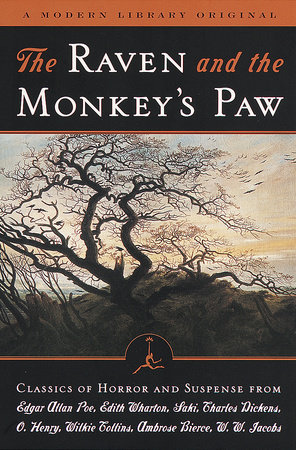
The Raven and the Monkey's Paw
By Edgar Allan Poe, Edith Wharton, Saki, Charles Dickens and O. Henry
-
$15.00
Published on Sep 29, 1998 | 224 Pages
Author
Edgar Allan Poe
Edgar Allan Poe was born in Boston, USA, in 1809. Poe, short story writer, editor and critic, he is best known for his macabre tales and as the progenitor of the detective story. He died in 1849, in mysterious circumstances, at the age of forty.J. Gerald Kennedy is Boyd Professor of English Emeritus at Louisiana State University and a past president of the Poe Studies Association. His books on Poe include Poe, Death, and the Life of Writing (1987), “The Narrative of Arthur Gordon Pym” and the Abyss of Interpretation (1995), and several edited volumes including A Historical Guide to Edgar Allan Poe (2001), Romancing the Shadow: Poe and Race (2001; with Liliane Weissberg), and Poe and the Remapping of Antebellum Print Culture (2012; with Jerome McGann). His major contribution to American literary studies is Strange Nation: Literary Nationalism and Cultural Conflict in the Age of Poe (2016), written with the support of fellowships by the John Simon Guggenheim Memorial Foundation and the National Endowment for the Humanities. He has also published Imagining Paris: Exile, Writing, and American Identity (1993), and he edited the Penguin Classics edition of The Life of Black Hawk (2008). He has appeared in many Poe documentary films, including The Mystery of Edgar Allan Poe(1994) for the A&E Biography series and Eric Stange’s film for the PBS American Masterpiece series, Edgar A. Poe: Buried Alive (2017).
Learn More about Edgar Allan PoeAuthor
Edith Wharton
The upper stratum of New York society into which Edith Wharton was born in 1862 provided her with an abundance of material as a novelist but did not encourage her growth as an artist. Educated by tutors and governesses, she was raised for only one career: marriage. But her marriage, in 1885, to Edward Wharton was an emotional disappointment, if not a disaster. She suffered the first of a series of nervous breakdowns in 1894. In spite of the strain of her marriage, or perhaps because of it, she began to write fiction and published her first story in 1889. Her first published book was a guide to interior decorating, but this was followed by several novels and story collections. They were written while the Whartons lived in Newport and New York, traveled in Europe, and built their grand home, the Mount, in Lenox, Massachusetts. In Europe, she met Henry James, who became her good friend, traveling companion, and the sternest but most careful critic of her fiction. The House of Mirth (1905) was both a resounding critical success and a bestseller, as was Ethan Frome (1911). In 1913 the Whartons were divorced, and Edith took up permanent residence in France. Her subject, however, remained America, especially the moneyed New York of her youth. Her great satiric novel, The Custom of the Country was published in 1913 and The Age of Innocence won her the Pulitzer Prize in 1921. In her later years, she enjoyed the admiration of a new generation of writers, including Sinclair Lewis and F. Scott Fitzgerald. In all, she wrote some 30 books, including an autobiography, A Backward Glance (1934). She died at her villa near Paris in 1937.
Learn More about Edith WhartonAuthor
Saki
Saki is the pen name of H. H. Munro, born in 1870 in Burma and educated in England. He began his writing career as a journalist and foreign correspondent but later turned to writing fiction—predominantly short stories for which he is best remembered—as well as one history book. He was 43 when World War I started. Although he was beyond the age of conscription, and despite being offered an officer’s commission, Saki joined the army as an ordinary trooper. He was killed in 1916 in France by a German sniper.
Learn More about SakiAuthor
Charles Dickens
Charles Dickens was born in a little house in Landport, Portsea, England, on February 7, 1812. The second of eight children, he grew up in a family frequently beset by financial insecurity. When the family fortunes improved, Charles went back to school, after which he became an office boy, a freelance reporter, and finally an author. With Pickwick Papers (1836–37) he achieved immediate fame. In a few years he was easily the most popular and respected writer of his time. It has been estimated that one out of every ten persons in Victorian England was a Dickens reader. Oliver Twist (1837), Nicholas Nickleby (1838–39), and The Old Curiosity Shop (1840-41) were huge successes. Martin Chuzzlewit (1843–44) was less so, but Dickens followed it with his unforgettable, A Christmas Carol (1843), Bleak House (1852–53), Hard Times (1854), and Little Dorrit (1855–57), which reveal his deepening concern for the injustices of British society. A Tale of Two Cities (1859), Great Expectations (1860–61), and Our Mutual Friend (1864–65) complete his major works.
Learn More about Charles DickensAuthor
O. Henry
O. Henry is the pseudonym of William Sydney Porter (1862–1910) and the name under which he published all of his work, which includes a novel and some 300 short stories. His talent for vivid caricature, local tone, narrative agility, and compassion tempered by irony made him a vastly popular writer in the last decade of his life. He was born in Greensboro, North Carolina, to ordinary middle-class parents and worked in an uncle’s drugstore as a youth, becoming a certified pharmacist. Like many southerners after the Civil War, Porter sought his fortune in the West, holding various jobs such as that of a clerk in a land office and a teller at an Austin bank. Charged with embezzlement in 1894, he fled to Honduras, returning in 1897 to be with his ill and dying wife. His conviction was caused more by his eluding trial than by the conflicting evidence of theft. In the Ohio State Penitentiary, Porter began to write the stories that made him famous. After his release, he moved to New York, remarried, and kept his identity a secret from all but a few friends. Porter is buried in Asheville, North Carolina. He is universally honored for his mastery of the short story and for his humane spirit.
Learn More about O. Henry