*Deidre Carmody
The New York Times
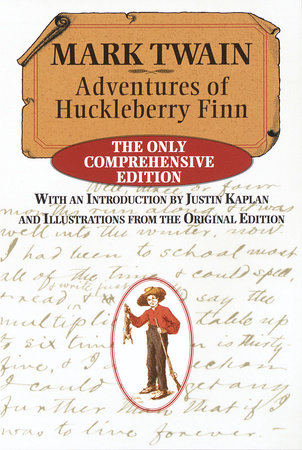
Now, in this extraordinary literary discovery, the original first half of Mark Twain’s American masterpiece is available for the first time ever to a general readership. Lost for more than a century, the passages reinstated in this edition reveal a novel even more controversial than the version Twain published in 1885, and provide an invaluable insight into his creative process.
The changes that Mark Twain made indicate that he frequently checked his impulse to write an even darker, more confrontational work than the book he finally published. Even in its smallest variations, the original manuscript demonstrates the skill, the restraint, and the constraints that affected Mark Twain’s thinking. This edition, then, not only presents the Huckleberry Finn that has delighted and provoked readers everywhere for more than a century, but also brings forward the original book behind the book.
A breakthrough of unparalleled impact, this comprehensive edition of an American classic is the final rebuttal in the tireless debate of "what Mark Twain really meant."
"[A] masterly restoration . . . I wish this new version of Huckleberry Finn would be distributed to all the nation’s classrooms as the basic text and lead to a badly needed reconsideration of the questions it raises."
*James A. McPherson
Chicago Tribune
"Thoughtfully respects Twain’s intentions."
*Gary Lee Stronum
The Cleveland Plain Dealer
With a foreword and addendum by Victor Doyno
Author
Mark Twain
MARK TWAIN, considered one of the greatest writers in American literature, was born Samuel Clemens in Florida, Missouri, in 1835, and died in Redding, Connecticut in 1910. As a young child, he moved with his family to Hannibal, Missouri, on the banks of the Mississippi River, a setting that inspired his two best-known novels, The Adventures of Tom Sawyer and Adventures of Huckleberry Finn. In his person and in his pursuits, he was a man of extraordinary contrasts. Although he left school at 12 when his father died, he was eventually awarded honorary degrees from Yale University, the University of Missouri, and Oxford University. His career encompassed such varied occupations as printer, Mississippi riverboat pilot, journalist, travel writer, and publisher. He made fortunes from his writing but toward the end of his life he had to resort to lecture tours to pay his debts. He was hot-tempered, profane, and sentimental—and also pessimistic, cynical, and tortured by self-doubt. His nostalgia for the past helped produce some of his best books. He lives in American letters as a great artist, described by writer William Dean Howells as “the Lincoln of our literature.” Twain and his wife, Olivia Langdon Clemens, had four children—a son, Langdon, who died as an infant, and three daughters, Susy, Clara, and Jean.
Learn More about Mark Twain