MEDITATIONS
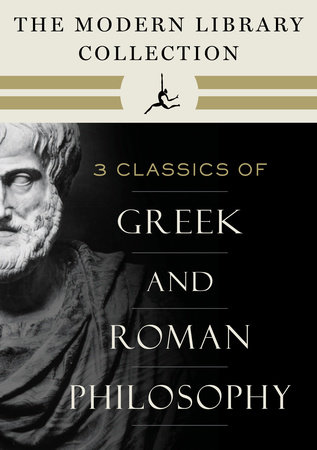
Marcus Aurelius succeeded his adoptive father as emperor of Rome in A.D. 161—and Meditations remains one of the greatest works of spiritual and ethical reflection ever written. The Meditations have become required reading for statesmen and philosophers alike, while generations of readers have responded to the straightforward intimacy of the leader’s style. In Gregory Hays’s seminal translation, Marcus’s thoughts speak with a new immediacy: Never before have they been so directly and powerfully presented.
SELECTED DIALOGUES OF PLATO
In this volume, Hayden Pelliccia has revised five of Benjamin Jowett’s translations of Plato—classics in their own right—to produce a fresh, modern take that Library Journal calls “a needed and welcome addition to the translations of the Dialogues.” Here are Ion, Protagoras, Phaedrus, and the famous Symposium, which discuss poetry, the Socratic method, rhetoric, psychology, and love. Most dramatically, Apology puts Socrates’ art of persuasion to the ultimate test—defending his own life.
THE BASIC WORKS OF ARISTOTLE
Preserved by Arabic mathematicians and canonized by Christian scholars, Aristotle’s works have shaped Western thought, science, and religion for nearly two thousand years—and Richard McKeon’s edition has long been considered the best available one-volume Aristotle. Here are selections from the Organon, On the Heavens, The Short Physical Treatises, Rhetoric, among others, and On the Soul, On Generation and Corruption, Physics, Metaphysics, Nicomachean Ethics, Politics, and Poetics in their entirety.
Author
Marcus Aurelius
Marcus Aurelius Antoninus was born to an upper-class Roman family in A.D. 121 and was later adopted by the future emperor Antoninus Pius, whom he succeeded in 161. His reign was marked by a successful campaign against Parthia, but was overshadowed in later years by plague, an abortive revolt in the eastern provinces, and the deaths of friends and family, including his co-emperor Lucius Verus. A student of philosophy from his earliest youth, he was especially influenced by the first-century Stoic thinker Epictetus. His later reputation rests on his Meditations, written during his later years and never meant for formal publication. He died in 180, while campaigning against the barbarian tribes on Rome’s northern frontier.
Learn More about Marcus AureliusAuthor
Plato
Plato, with Socrates and Aristotle, is the founder of the Western intellectual tradition. Like his mentor Socrates, he was essentially a practical philosopher who found the abstract theory and visionary schemes of many contemporary thinkers misguided and sterile. He was born about 429 BCE in Athens, the son of a prominent family that had long been involved in the city’s politics. Extremely little survives of the history of Plato’s youth, but he was raised in the shadow of the great Peloponnesian War, and its influence must have caused him to reject the political career open to him and to become a follower of the brilliantly unorthodox Socrates, the self-proclaimed “gadfly” of Athens. Socrates’ death in 399 BCE turned Plato forever from politics, and in the next decade he wrote his first dialogues, among them Apology and Euthyphro. At age 40, Plato visited Italy and Syracuse, and upon his return he founded the Academy-Europe’s first university—in a sacred park on the outskirts of Athens. The Academy survived for a millennium, finally closed by the emperor Justinian in 529. Plato hoped his school would train its pupils to carry out a life of service and to investigate questions of science and mathematics. Plato’s old age was probably devoted to teaching and writing, he died in Athens in 348 BCE.
Learn More about PlatoAuthor
Aristotle
Aristotle was born at Stageira, in the dominion of the kings of Macedonia, in 384 BCE. For 20 years he studied at Athens in the Academy of Plato, on whose death in 347 he left, and, sometime later, became tutor of the young Alexander the Great. When Alexander succeeded to the throne of Macedonia in 335, Aristotle returned to Athens and established his school and research institute, the Lyceum, to which his great erudition attracted a large number of scholars. After Alexander’s death in 323, anti-Macedonian feeling drove Aristotle out of Athens, and he fled to Chalcis in Euboea, where he died in 322. His writings, which were of extraordinary range, profoundly affected the whole course of ancient and medieval philosophy, and they are still eagerly studied and debated by philosophers today. Very many of them have survived and among the most famous are the Ethics and the Politics.
Learn More about Aristotle