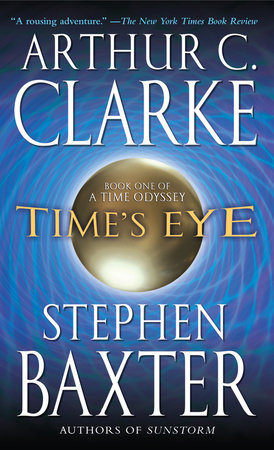
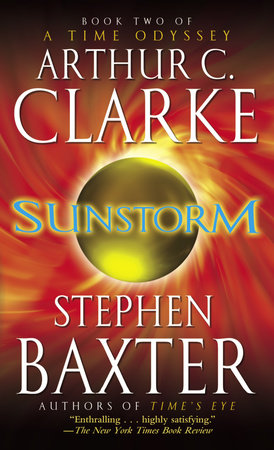
In an instant, Earth is carved up in time and reassembled like a huge jigsaw puzzle. Suddenly the world becomes a patchwork of eras, from prehistory to 2037, each with its own indigenous inhabitants. The explanation for this cataclysmic event may lie in the ancient city of Babylon, where two groups of refugees from 2037—three cosmonauts and three U.N. peacekeepers—have detected strange radio signals. The peacekeepers find allies in nineteenthcentury British troops and in the armies of Alexander the Great. The cosmonauts join forces with the Mongol horde led by Genghis Khan. Both sides set out for Babylon, vowing to win the race for knowledge—as a powerful and mysterious entity watches, waiting.
Praise for Time’s Eye
“A rousing adventure.”—The New York Times Book Review
“By the end, when two of history’s most ambitious conquerors meet, we are so thoroughly invested in the characters, we can’t wait for the sequel.”—Entertainment Weekly (Editor’s Choice)
“A fast and engaging read.”—Rocky Mountain News
Author
Arthur C. Clarke
Sir Arthur C. Clarke (1917-2008) wrote a hundred books and more than a thousand short stories and essays covering science fiction and science fact in a career spanning more than six decades. Among his bestselling novels are Childhood’s End, 2001: A Space Odyssey, and Rendezvous with Rama. In 1945, he proposed global broadcasting via communication satellites in geostationary orbit. One of his short stories inspired the World Wide Web, while another was expanded into 2001: A Space Odyssey, which he cowrote with Stanley Kubrick. Born in Somerset, England, Clarke was educated at King’s College, London. He worked in the British civil service and the Royal Air Force before turning full-time author in 1950. The recipient of dozens of awards, fellowships, and honorary doctorates, Clarke had both an asteroid and dinosaur species named after him. Queen Elizabeth II gave him a knighthood in 1998. Clarke lived in Sri Lanka since 1956, engaged in diving, astronomical observations, and underwater tourism.
Learn More about Arthur C. ClarkeAuthor
Stephen Baxter
Stephen Baxter is a trained engineer with degrees from Cambridge and Southampton Universities. Baxter is the winner of both the British Science Fiction Association Award and the Locus Award, as well as being a nominee for an Arthur C. Clarke Award, most recently for Manifold: Time. His novel Voyage won the Sidewise Award for Alternate History in Long Form. He also won the John W. Campbell Award and the Philip K. Dick Award for his novel The Time Ships.
Learn More about Stephen Baxter