


Best Seller
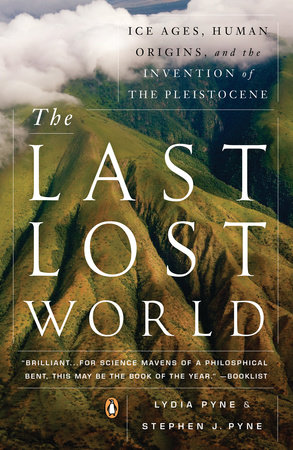
The Last Lost World
By Lydia Pyne and Stephen J. Pyne
By Lydia Pyne and Stephen J. Pyne
Ebook
Published on Jun 14, 2012 | 320 Pages



An enlightening investigation of the Pleistocene’s dual character as a geologic time—and as a cultural idea
The Pleistocene is the epoch of geologic time closest to our own. It’s a time of ice ages, global migrations, and mass extinctions—of woolly rhinos, mammoths, giant ground sloths, and not least early species of Homo. It’s the world that created ours.
But outside that environmental story there exists a parallel narrative that describes how our ideas about the Pleistocene have emerged. This story explains the place of the Pleistocene in shaping intellectual culture, and the role of a rapidly evolving culture in creating the idea of the Pleistocene and in establishing its dimensions. This second story addresses how the epoch, its Earth-shaping events, and its creatures, both those that survived and those that disappeared, helped kindle new sciences and a new origins story as the sciences split from the humanities as a way of looking at the past.
Ultimately, it is the story of how the dominant creature to emerge from the frost-and-fire world of the Pleistocene came to understand its place in the scheme of things. A remarkable synthesis of science and history, The Last Lost World describes the world that made our modern one.
Author
Lydia Pyne
Lydia Pyne has degrees in history and anthropology and a PhD in history and philosophy of science from Arizona State University. She has participated in field and archival work in South Africa, Ethiopia, Uzbekistan, Iran, and the American Southwest. She has published articles and essays in The Atlantic, Nautilus, and Public Domain Review. She lives in Austin, Texas, where she is an avid rock climber and mountain biker.
Learn More about Lydia PyneAuthor
Stephen J. Pyne
Stephen J. Pyne is a professor of history at Arizona State University, a MacArthur Foundation Fellow, and winner of the 1995 Los Angeles Times Robert Kirsch Award for Arts and Letters. His book The Ice was named one of The New York Times Book Review’s 10 Best Books of the Year. His eleven groundbreaking books include the five-volume Cycle of Fire. He lives in Glendale, Arizona.
Learn More about Stephen J. Pyne QUICK VIEW
 QUICK VIEW
 QUICK VIEW
 QUICK VIEW
 QUICK VIEW
 QUICK VIEW
 QUICK VIEW
 QUICK VIEW
 QUICK VIEW
 QUICK VIEW