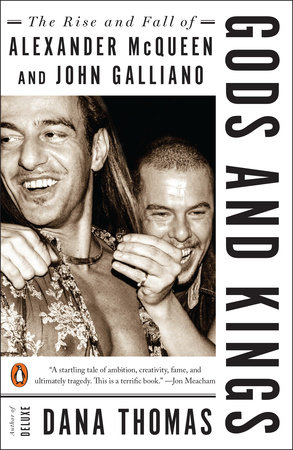

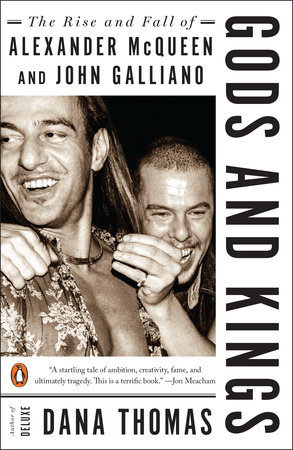

Their approach to fashion was wildly different—Galliano began as an illustrator, McQueen as a Savile Row tailor. Galliano led the way with his sensual bias-cut gowns and his voluptuous hourglass tailoring, which he presented in romantic storybook-like settings. McQueen, though nearly ten years younger than Galliano, was a brilliant technician and a visionary artist who brought a new reality to fashion, as well as an otherworldly beauty. For his first official collection at the tender age of twenty-three, McQueen did what few in fashion ever achieve: he invented a new silhouette, the Bumster.
They had similar backgrounds: sensitive, shy gay men raised in tough London neighborhoods, their love of fashion nurtured by their doting mothers. Both struggled to get their businesses off the ground, despite early critical success. But by 1997, each had landed a job as creative director for couture houses owned by French tycoon Bernard Arnault, chairman of LVMH.
Galliano’s and McQueen’s work for Dior and Givenchy and beyond not only influenced fashion; their distinct styles were also reflected across the media landscape. With their help, luxury fashion evolved from a clutch of small, family-owned businesses into a $280 billion-a-year global corporate industry. Executives pushed the designers to meet increasingly rapid deadlines. For both Galliano and McQueen, the pace was unsustainable. In 2010, McQueen took his own life three weeks before his womens’ wear show.
The same week that Galliano was fired, Forbes named Arnault the fourth richest man in the world. Two months later, Kate Middleton wore a McQueen wedding gown, instantly making the house the world’s most famous fashion brand, and the Metropolitan Museum of Art opened a wildly successful McQueen retrospective, cosponsored by the corporate owners of the McQueen brand. The corporations had won and the artists had lost.
In her groundbreaking work Gods and Kings, acclaimed journalist Dana Thomas tells the true story of McQueen and Galliano. In so doing, she reveals the revolution in high fashion in the last two decades—and the price it demanded of the very ones who saved it.
Author
Dana Thomas
Dana Thomas is the author of Fashionopolis: The Price of Fast Fashion and the Future of Clothes, Fashionopolis Young Readers Edition, Gods and Kings: The Rise and Fall of Alexander McQueen and John Galliano and the New York Times bestseller Deluxe: How Luxury Lost Its Luster, all published by Penguin Press. She is the European Sustainability Editor for British Vogue, a regular contributor to the New York Times, and hosts “The Green Dream,” a weekly podcast on sustainability, produced by Wondercast.Studio. She wrote the screenplay for Salvatore: Shoemaker of Dreams, a feature documentary directed by Luca Guadagnino, which premiered at the Venice Film Festival in 2020. Thomas began her career writing for the Style section of The Washington Post, and for fifteen years she served as a cultural and fashion correspondent for Newsweek in Paris. Thomas has written for The New York Times Magazine, The New Yorker, The Wall Street Journal, the Financial Times, Vogue, Harper’s Bazaar, T: The New York Times Style Magazine, and Architectural Digest. In 1987, she received the Sigma Delta Chi Foundation’s Ellis Haller Award for Outstanding Achievement in Journalism. In 2016, the French Minister of Culture named Thomas a Chevalier of the Order of Arts and Letters. And in 2017, she was a Logan Nonfiction Fellow at the Carey Institute for Global Good. She lives in Paris.
Learn More about Dana Thomas