1. You’ve had successful careers in both theater and television. What made you decide to write novels?
My first love was fiction. When I was six years old and running around saying I wanted to be a writer, I wanted to write these little books about frogs, I didn’t want to write plays. And then things changed as I got a little older. I was acting a lot and writing short stories in high school and I just sort of drifted into playwriting. I think I was sixteen when I wrote my first play, but I was six when I wrote my first novel—which was maybe fifteen words long. I actually have a PhD in Victorian literature, and my area was fiction, so when I was coming of age, being someone who thinks about writing all the time, it was in the company of Dickens, the Brontë sisters, George Eliot, Tolstoy, and Dostoyevsky. So I was surprised that I started writing plays. I’m still surprised I write plays. But I was so humbled by the novel that my courage failed me. Until…it didn’t.
2. How is writing a novel different from writing a play, or writing a television show? Is there one form you feel most natural working with?
The obvious difference is that in fiction, there is a narrative voice that is central to the storytelling. And in dramatic writing, the narrative voice steps behind the characters. But in fiction, the narrative voice is, if anything, the most important character. Some days I feel like theater is the most natural form for me, but then other days I feel like it’s fiction or nothing. Television is a hard form because there are so many people involved, so much politics that you have to negotiate, and it’s hard as a writer to feel like you’re constantly talking to people and having to deliver what they want even when they don’t know what they want. It goes on and on. One of the things I really love about fiction writing is how it fulfills itself without a lot of people outside of the ones who are within the writing.
I’ve always been extremely curious about different kinds of writing. I’m not the only person this has happened to. Oscar Wilde used to hop genres. Michael Freen hops genres. Shaw, who is a huge influence on everything I write, was a mighty essayist and critic, along with one of the greatest playwrights. There are more of us out there than you think.
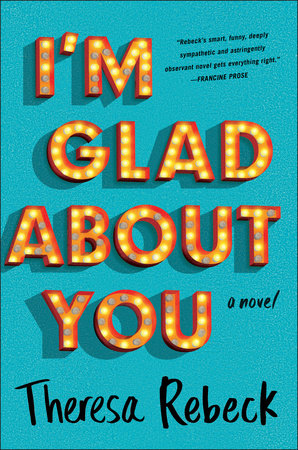
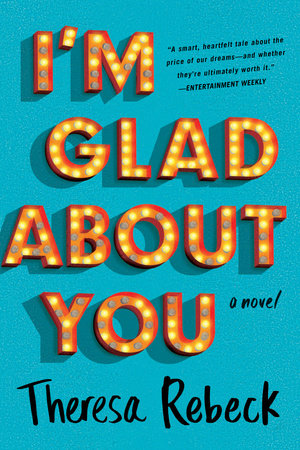
3. I’m Glad About You highlights the differences between life in New York City and life in suburban Ohio. Why did you write about these two places?
All of my adult life, I’ve literally bounced back and forth between those two places. Like my heroine, I grew up in Cincinnati and then landed in New York. It’s been peculiar to discover how neither identity takes over. I feel very much a child of the Midwest as well as a New Yorker. But I think that America doesn’t know how to talk to itself. And so even though I’ve only ever been a citizen of America, I feel like a creation of two different countries—the Midwest and the Northeast.
4. What inspired you to write I’m Glad About You? Alison and Kyle both feel so real. Is there a true story behind these two characters?
There were true details behind the novel. But the characters are their own selves.
5. How did the title of the novel come about? What is its significance?
A friend of mine told me about trying to learn Navajo. She had a book called Navajo Made Easier. And she discovered this fact in her studies that the Navajo don’t believe in possession the same way that people in Western cultures do. She explained to me this beautiful fact about their concept of love: that the word “love” has the connotation of possession in it, and so the closest word in Navajo that expresses their idea of love sort of literally translates to, “I’m glad about you.”
Because of the cross purposes that appear in the relationship between Kyle and Alison, it felt to me like they could either destroy each other or release into this broader idea. I don’t want to say “broader idea of the love,” because the word “love” is the problem. Their hearts need to open around who they are to each other.
6. While I’m Glad About You is a fun and fast-paced novel, it also tackles some serious issues, including Hollywood’s expectations of beauty, what it’s like to be a woman in the film industry, and what it means to be a modern-day Catholic. What drew you to these topics?
Well, I’ve done a lot of work in film and television, and I’m always astonished by the bizarre assumptions that go unexamined and unchecked in Hollywood. But you can say the same thing about Catholicism. I grew up Catholic, and I remain astonished around the bizarre assumptions that go unexamined and unchecked. So it’s not like anything drew me to this material, it’s just the sea that I swim in.
7. You’ve spent a lot of time working in television and Hollywood. Can you tell us a bit about working in these industries as a woman? What has your experience been like?
Let me just reiterate, it’s so much fun to tell stories on film. Sets are fantastic. Weird and exciting. You feel really alive when you actually get to do it. Being in an editing room is an amazing experience. And you get to work with a lot of other artists who are obsessed in the best way. At the work level, it’s profoundly satisfying. And the crews are, by and large, terrific. There are a lot of guys on a crew who are really macho dudes but they’re terrific, both flirty and kind, extremely respectful of everyone involved—because there’s so much work to be done and everybody has to work as a team. Having said that, it’s always felt to me that where things really go awry is in the power structure. There’s a whole different culture that is involved in a level of cronyism that is actively toxic, hostile to women. Assuming a very narrow idea of how women should behave and be perceived. It sort of feels upside-down. You’d assume that all those guys on the set would be old school about their ideas about women. And maybe they are, in private. But in the workplace, if you can hold your own, that’s all anybody cares about. There’s more of a cultural issue in the offices.
8. You write from both the female and male perspective in the novel. Was there one voice that was harder to capture than another? Do you have a favorite character in the novel?
No, I like everybody.
9. Without giving anything away, could you speak a bit about the ending? Did you know where the story would go when you began writing?
I did know where the story was going, however, it went lots of other places. I had a very clear idea of what I wanted, and that was derailed about ten times. And then at an important moment, my agent said to me, You have to make sure this is the novel you wanted to write. So I went back to my original concept and found that all the work I’d done supported the idea I had from the beginning.
10. What is next for you? Any more books in the works?
I have an idea that I’d like to write a saga. And that’s starting to take up a lot of room in my head, as, of course, it would.






 QUICK VIEW