“Nasaw, who has written well-regarded biographies of Andrew Carnegie and William Randolph Hearst, makes clear how much the Allied forces wished that those in the displaced remnant would simply go back to wherever it was they came from. (At one point, Fiorello La Guardia tried to talk the Poles into it.) Nasaw also captures the power of refusing to leave—the decision not to disperse. This isn’t to say that the goal of the Last Million was to stay in Germany forever. By not going through one door, they were trying to open others. For the Jews, the main options were, as Rosensaft laid them out, Palestine or some other place that had not been the recent site of genocidal murder, and the central conflict of ‘The Last Million’ is the fight, in the years following the war, over which it was going to be…A great contribution of Nasaw’s book is that it takes the cinematic moment in which American soldiers arrive and pronounce the nightmare over—‘Shalom Aleichem, Yidden, ihr zint frei,’ a Jewish chaplain from Brooklyn announced when he drove into Buchenwald—as a starting point rather than a closing scene.” —The New Yorker
“In The Last Million, Nasaw has done a real service in resurrecting this history . . . Anyone who thinks President Trump’s demonization of foreigners is an aberration should read this history.” —Washington Post
“David Nasaw devastatingly illustrates in ‘The Last Million,’ there was widespread reluctance among the victorious Allies to confront the true nature of the Holocaust…“The Last Million” describes in meticulously researched detail what happened to the [displaced persons] who felt—understandably enough—that they could not go back to the lands of their birth.” —Wall Street Journal
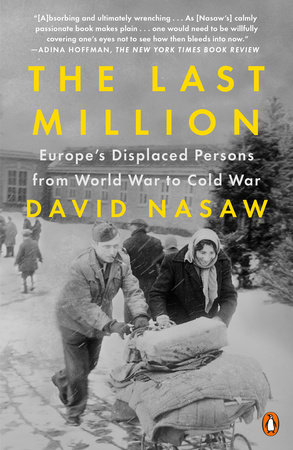
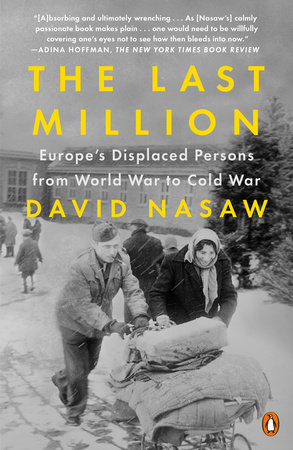
“One of the many virtues of ‘The Last Million’ is the author’s ability to make vivid sense of a bewildering moment. He clarifies without oversimplifying…Nasaw demonstrates throughout an especially supple sense of scale. Much of what makes the book so absorbing and ultimately wrenching is his capacity to maneuver with skill between the nitty-grittiest of diplomatic (and congressional, military, personal) details and the so-called Big Picture. In cinematic terms, he’s adroit at surveying a vast landscape with a soaring crane shot, then zooming in sharply for a close-up of a single face as it crumples… Nasaw takes pains to avoid facile comparisons between the history he recounts and the current global moment, with its — our — own seas of refugees. As his calmly passionate book makes plain, however, one would need to be willfully covering one’s eyes not to see how then bleeds into now.” —Adina Hoffman, The New York Times Book Review
“Insightful and eye-opening…Nasaw is a humane writer with a knowledge of his subject that is broad and deep.” —Jim Zarroli, NPR.org
“Based on an avalanche of research, sweeping, searching, and filled with intimate details, The Last Million tells the enduringly relevant and not well-known story of how political differences between the United States and the United Kingdom, Cold War calculations, ethnic and religious conflicts, and antisemitism trumped humanitarian considerations, ‘turning what should have been the primary mission upside down and victimizing those who had suffered the most.’” —Glenn C. Altschuler, The Jerusalem Post
“Tells of the last million who had been confined to refugee camps for five years….Through great research, Nasaw helps the reader understand the complexity of permanently relocating refugees to a new country.” —Seattle Times
“Nasaw, a two-time Pulitzer Prize finalist, has once again produced an extraordinarily well-researched book that is well worth reading.” —Christian Science Monitor
“Nasaw does a masterful job of bringing to light the lasting individual and global consequences of policies and attitudes surrounding the last million… A thought-provoking, highly recommended perspective on a complex and largely overlooked people and period of modern history.” —Library Journal, starred review
“[Nasaw] provides a characteristically thorough and impressively researched account of the roughly one million displaced persons who found themselves stranded in Germany after the end of the war…While delving into the weeds of political compromise and legislation, Nasaw never loses sight of the hopes and struggles of the people at the center…The Last Million showcases Nasaw’s deft handling of complexity—not only the number of global controversies that the Displaced Persons issue fed into, but the morally complex issues of collaboration.” —Shelf Awareness
“A richly detailed account of what happened to the one million Holocaust survivors, former slave laborers, and POWs who found themselves in Germany at the end of WWII . . . Nasaw skillfully and movingly relates a multilayered story with implications for contemporary refugee crises. This meticulously researched history is a must-read.” —Publishers Weekly, starred review
“[M]asterful…A searching, vigorously written history of an unsettled time too little known to American readers.” —Kirkus Reviews, starred review







 QUICK VIEW