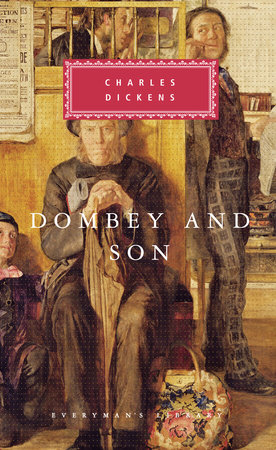
It is said that all England mourned the heartbreaking fate of little Paul Dombey, but it is the ordeal of his loving and long-suffering sister, Florence, that carries the full emotional weight of the story. Their father’s cold obsession with the future of his business empire, the malevolent plotting of his greedy manager, Mr. Carker, and the tragic self-contempt of his proud second wife, Edith, cast a dark shadow over the life of the motherless girl. But as the world of Dombey and Son begins to fall to pieces, Florence is sustained by the warmth and brightness of humbler allies: her fiercely loyal nurse, Susan Nipper; her haplessly devoted suitor, Toots; the rough but loveable old salt Captain Cuttle and his friend Sol Gills; and her fervent admirer, the orphan Walter Gay. In its locomotive power and its transcendent moments of suspense and revelation, Dombey and Son is a superb example of Dickens’s ability to combine the qualities of a social historian, a theatrical artist, and a poet of the utmost tenderness and insight.
Charles Dickens set this tale of a hard-hearted businessman, the son he pins all his hopes on, and the daughter he cruelly neglects in a country undergoing the storms of change brought by the Industrial Revolution.
This edition reprints the original Everyman’s introduction by G.K. Chesterton and includes forty illustrations by Phiz.
Author
Charles Dickens
Charles Dickens was born in a little house in Landport, Portsea, England, on February 7, 1812. The second of eight children, he grew up in a family frequently beset by financial insecurity. When the family fortunes improved, Charles went back to school, after which he became an office boy, a freelance reporter, and finally an author. With Pickwick Papers (1836–37) he achieved immediate fame. In a few years he was easily the most popular and respected writer of his time. It has been estimated that one out of every ten persons in Victorian England was a Dickens reader. Oliver Twist (1837), Nicholas Nickleby (1838–39), and The Old Curiosity Shop (1840-41) were huge successes. Martin Chuzzlewit (1843–44) was less so, but Dickens followed it with his unforgettable, A Christmas Carol (1843), Bleak House (1852–53), Hard Times (1854), and Little Dorrit (1855–57), which reveal his deepening concern for the injustices of British society. A Tale of Two Cities (1859), Great Expectations (1860–61), and Our Mutual Friend (1864–65) complete his major works.
Learn More about Charles Dickens