When John Harmon—who has been left a fortune if he will marry the girl his miserly father chose for him—is found floating dead in the Thames, he sets in motion a story overflowing with cases of deception and mistaken identity, of murder and attempted murder, of sin and redemption. The influence of the notorious Harmon inheritance ripples through a large cast of vividly drawn characters from every level of society, including Noddy Boffin, known as “the Golden Dustman”; the one-legged villain Silas Wegg; willful Bella Wilfer; saintly Lizzie Hexam; the sharp-witted doll’s dressmaker Jenny Wren; the social-climbing Veneerings; the ruthless speculator Fascination Fledgeby; and the river-scavenging corpse robbers Gaffer Hexam and Rogue Riderhood. Out of this flurry of invention Dickens creates in Our Mutual Friend a portrait of a city and a civilization that is at once indignant, compassionate, and utterly unforgettable.
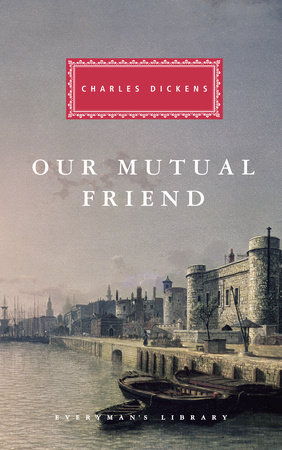
Charles Dickens’s last completed novel features one of his most surreal and haunting visions of London, shadowed by towering dust heaps that supply the corrupting riches at the heart of the plot and washed by the dark river that winds its way insistently through the story.
This edition reprints the original Everyman’s preface by G. K. Chesterton and features forty illustrations by Marcus Stone.
Author
Charles Dickens
Charles Dickens was born in a little house in Landport, Portsea, England, on February 7, 1812. The second of eight children, he grew up in a family frequently beset by financial insecurity. When the family fortunes improved, Charles went back to school, after which he became an office boy, a freelance reporter, and finally an author. With Pickwick Papers (1836–37) he achieved immediate fame. In a few years he was easily the most popular and respected writer of his time. It has been estimated that one out of every ten persons in Victorian England was a Dickens reader. Oliver Twist (1837), Nicholas Nickleby (1838–39), and The Old Curiosity Shop (1840-41) were huge successes. Martin Chuzzlewit (1843–44) was less so, but Dickens followed it with his unforgettable, A Christmas Carol (1843), Bleak House (1852–53), Hard Times (1854), and Little Dorrit (1855–57), which reveal his deepening concern for the injustices of British society. A Tale of Two Cities (1859), Great Expectations (1860–61), and Our Mutual Friend (1864–65) complete his major works.
Learn More about Charles Dickens