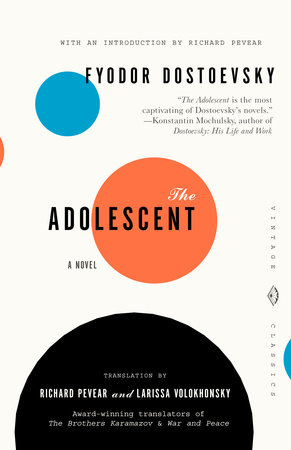


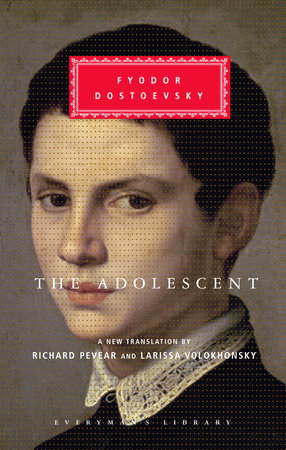

The illegitimate son of a landowner, Arkady Dolgoruky was raised by foster parents and tutors, and has scarcely ever seen his father, Versilov, and his mother, Versilov’s peasant common-law wife. Arkady goes to Petersburg to meet this “accidental family” and to confront the father who dominates his imagination and whom he both disdains and longs to impress. Having sewn into his coat a document that he believes gives him power over others, Arkady proceeds with an irrepressible youthful volatility that withstands blunders and humiliations at every turn.
Dostoevsky masterfully depicts adolescence as a state of uncertainty, ignorance, and incompleteness, but also of richness and exuberance, in which everything is still possible. His tale of a youth finding his way in the disorder of Russian society in the 1870s is a high and serious comedy that borders on both farce and tragedy.
The Adolescent (originally published in English as A Raw Youth) is markedly different in tone from Dostoevsky’s other masterpieces. It is told from the point of view of the nineteen-year-old narrator, whose immaturity, freshness, and naïveté are unforgettably reflected in his narrative voice.
This superb new translation—never before published—of one of Dostoevsky’s major novels comes from the award-winning translators Richard Pevear and Larissa Volokhonsky.
Author
Fyodor Dostoevsky
Fyodor Mikailovich Dostoevsky’s life was as dark and dramatic as the great novels he wrote. He was born in Moscow in 1821. A short first novel, Poor Folk (1846), brought him instant success, but his writing career was cut short by his arrest for alleged subversion against Tsar Nicholas I in 1849. His prison experiences coupled with his conversion to a profoundly religious philosophy formed the basis for his great novels. But it was his fortuitous marriage to Anna Snitkina, following a period of utter destitution brought about by his compulsive gambling, that gave Dostoevsky the emotional stability to complete Crime and Punishment (1866), The Idiot (1868–1869), The Possessed (1871–1872), and The Brothers Karamazov (1879–1880). When Dostoevsky died in 1881, he left a legacy of masterworks that influenced the great thinkers and writers of the Western world and immortalized him as a giant among writers of world literature.
Learn More about Fyodor Dostoevsky