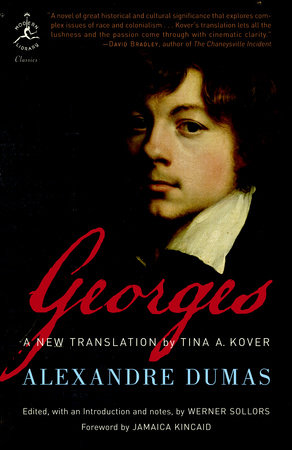
“Georges is an illuminating, instructive, and enduring blueprint of racial conflict and strife, as compelling and relevant today as it was back in the 1840s, when it was first published.”
–Adrienne Kennedy, author of Funnyhouse of a Negro
“I know this is a novel of great historical and cultural significance and that it explores complex issues of race and colonialism and all, but what matters to a guy like me is, it’s a hell of a read. Sea battles and land battles, a steamy setting and hot-blooded gallantries, ancient enmities and sweet revenge, forbidden love, insults and duels, bravado and bravery and redemption, hot pursuit and desperate flight and crushing captures and daring escapes. What a story! And Kover’s translation lets all the lushness and the romance and the passion come through with cinematic clarity.”
–David Bradley, author of The Chaneysville Incident
“A remarkable discovery that expands the corpus of Alexandre Dumas. Rendered in beautiful language, this is a tale that transports us to a time and place that still speaks to us in our present circumstances. We are indebted to Werner Sollors and Jamaica Kincaid for their framing documents that provide us with a critical lens for the journey Dumas has created for us out of his own generous and expansive imagination.”
–Rudolph P. Byrd, Emory University
“A brilliant example of the French Romantic novel, far too infrequently read and . . . deserving of a broader audience.”
–Barbara T. Cooper, professor of French, University of New Hampshire







 QUICK VIEW