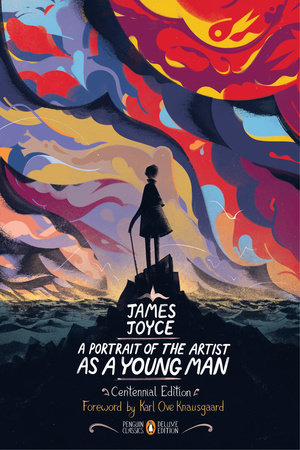
James Joyce’s supremely innovative fictional autobiography is also, in the apt phrase of the biographer Richard Ellmann, nothing less than "the gestation of a soul." For as he describes the shabby, cloying, and sometimes terrifying Dublin upbringing of his alter ego, Stephen Dedalus, Joyce immerses the reader in his emerging consciousness, employing language that ranges from baby talk to hellfire sermon to a triumphant artist’s manifesto. The result is a novel of immense boldness, eloquence, and energy, a work that inaugurated a literary revolution and has become a model for the portrayal of the self in our time.
The text of this edition has been newly edited by Hans Walter Gabler and Walter Hettche and is followed by a new afterword, chronology, and bibliography by Richard Brown.
Author
James Joyce
James Joyce, the twentieth century’s most influential novelist, was born in Dublin on February 2, 1882. The oldest of ten children, he grew up in a family that went from prosperity to penury because of his father’s wastrel behavior. After receiving a rigorous Jesuit education, twenty-year-old Joyce renounced his Catholicism and left Dublin in 1902 to spend most of his life as a writer in exile in Paris, Trieste, Rome, and Zurich. On one trip back to Ireland, he fell in love with the now famous Nora Barnacle on June 16, the day he later chose as “Bloomsday” in his novel Ulysses. Nora was an uneducated Galway girl who became his lifelong companion and the mother of his two children. In debt and drinking heavily, Joyce lived for 36 years on the Continent, supporting himself first by teaching jobs, then through the patronage of Mrs. Harold McCormick (Edith Rockerfeller) and the English feminist and editor Harriet Shaw Weaver. His writings include Chamber Music (1907), Dubliners (1914), A Portrait of the Artist as a Young Man (1916), Exiles (1918), Ulysses (1922), Pomes Penyeach (1927), Finnegan’s Wake (1939), and an early draft of A Portrait of a Young Man, Stephan Hero (1944). Ulysses required seven years to complete, and his masterpiece, Finnegan’s Wake, took seventeen. Both works revolutionized the form, structure, and content of the novel. Joyce died in Zurich in 1941.
Learn More about James JoyceIllustrator
Roman Muradov
ROMAN MURADOV is an award-winning editorial artist and graphic novelist who has created illustrations for The New Yorker, New York Times, Criterion, Vogue, Paris Review, Wired, the Wall Street Journal, TIME Magazine, GQ, Warby Parker, NPR, Monocle, Lucky Peach, Apple, Google, Airbnb, Lyft, Patreon and Dropbox, as well as the covers of the Penguin Classics Centennial Editions of James Joyce’s Dubliners and A Portrait of the Artist as a Young Man. He has won multiple medals from the Society of Illustrators as well as the Young Guns Award from the Art Directors Club, and his work has been featured in The Comics Journal, American Illustration and Creative Quarterly, among others. Roman currently teaches illustration at the California College of the Arts.
Learn More about Roman Muradov