A Conversation with Victoria Redel
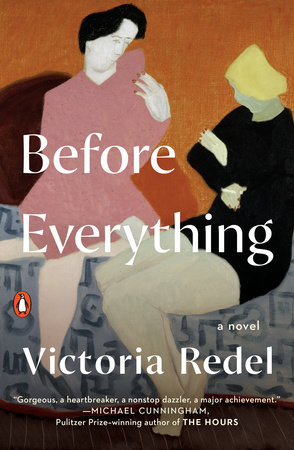
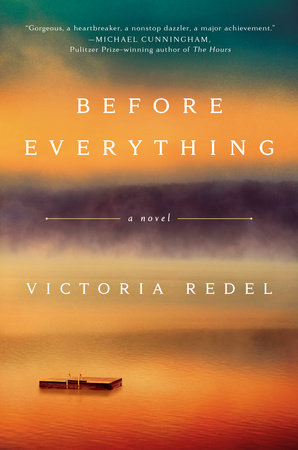
What is Before Everything about?
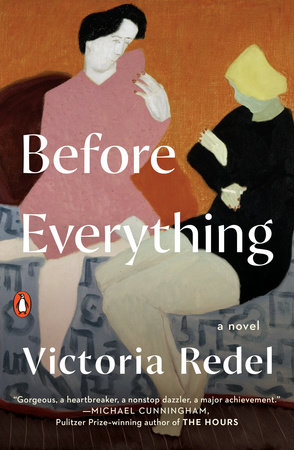
Ming, Caroline, Anna, Helen, and Molly are women who have been in one another’s lives since grade school. Now in their fifties, they’ve gathered at Anna’s house in Western Massachusetts because she’s dying. That makes the story sound sad from the get-go, but I don’t think it is. Or it is, but these friends are too funny, opinionated, and irreverent to navigate only through sadness. They fight for time alone with Anna because the hospice door keeps opening and locals, ex-husbands, a rock band show up. Eventually they up and steal Anna out of hospice, hightailing it on a road trip. Not all of the women agree that it should be Anna’s decision alone to stop treatment and this raises one of the novel’s central questions of how we live with one another’s choices. If we’re lucky, we get to do some of this together. But there is also the larger story beyond this tight-knit group. In other words it is a book about how one person impacts many lives.
What was the origin or inspiration for the novel?
There are usually a variety of inspirations for a novel, some more obvious than others. The simplest answer to this, however, is that my best friend, since I was seven years old, died. She’d always bugged me to write about friendship. I remember smugly telling her that you need a conflict to write a novel and my friendships were often the smoothest part of my life. After she passed away I began to think about the impact of illness on the lives of others. There was also so much of our lifelong friendship to celebrate and grieve, and I wanted a vessel to explore the themes of time and love and loss. I began to consider how women are witnesses to one another’s lives over the sweep of a lifetime. The ties between women are a kind of net and I’m intrigued by it’s strength and fragility.
What does the title mean?
Doctors have found that right at the moment before death there’s a great surge in brain activity, a bolt of energy. I hope the title Before Everything captures those pure moments in our lives—of both innocence and knowing—right before an enormous change.
During the Old Friends visit with Anna, Caroline says, “How is it that the ordinary continues?” Can you speak a little about what that means inside Before Everything?
For me the everyday, the small stuff, is the sacred and it is what I’m most interested in writing about. Yes, there is something unusual and dramatic happening as they face Anna’s death but it is through the small actions—bathing her, cooking for her, taking her on a final trip that give the characters opportunities for insight and feeling. With dying, like birthing, there’s a lot of waiting for the inevitable and inside that hanging around there are moments of beauty, humor, and even human heroics. It’s in the midst of the regular, the machine of the ordinary, that something unexpected happens.
Among the many points of view inside Before Everything, you include Anna’s, who slowly becomes less and less conscious. What was it like to enter her psyche?
Actually, this was the unexpected gift for me. It allowed me the chance to imagine a bit what my best friend might have experienced on her way out of the world. There was something comforting in the exploration. Some people say they’re not afraid of dying but I’ve always been afraid of death. It’s hard to imagine letting go. So to enter into a character that is letting go with sadness but without terrible anxiety was a revelation.
It’s almost as if memory and time become characters in the novel too.
I suppose it’s inevitable that time has a big role in a book about mortality. But I was, finally, more interested in time’s elasticity and fluidity rather than finiteness.
It is part of the pleasure of old friends—they’ve known you through a swath of time. All the shared history crowds every moment together and, as the conversation zips back and forth between the present and moments twenty years ago, linear time disappears. Old friends are witnesses to your life. They’ve endured your fads and dumb hair and fashion choices. They’ve known you through rough life mistakes. But just as there’s a collective or group memory, there’s also the different version of events experienced through an individual lens. This comes up for Caroline who had backed away from the others for a few years and is still navigating her sense of self in relation to the larger group. She has to figure out how to get out of her own way in order to be part of something more pressing than old hurts. I wanted time, memory, friendship, and love in this book to be as messy and unpredictable as I usually feel it is.
Hannah Tinti writes about Before Everything: “Victoria Redel bears witness to a remarkable group of women, effortlessly weaving back and forth through time, each thread revealing the cracks and secrets of their complex lives while also drawing them closer . . . She proves that female friendship is the quiet, steady engine that truly runs the world.” Was that part of what you set out to prove?
I love Hannah’s statement so much and I’m thrilled she had that to say about the novel. I think that the lives of ordinary women are not written about nearly enough. And, of course, there’s nothing ordinary about any life. I detest when people claim that women are “multitaskers” as what women have done through all of time can now be neatly summed up with this current business-efficiency phrase. It’s always been my ambition to allow women characters the whole big range—intellectual, sexual, emotional, maternal. Furious, funny, loyal, determined, frustrated. I could keep adding to the list—tough, resilient, fearful, brilliant. The women I know are all this and then some. I’m tired of simple dualities.






 QUICK VIEW