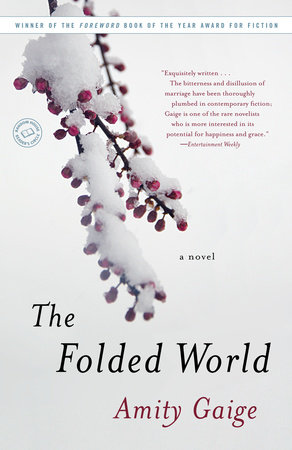
A Conversation with Amity Gaige
Random House Reader’s Circle: Was there something in particular that prompted you to become a writer? Did you choose writing as a profession or did it choose you?
Amity Gaige: That’s a hard question to answer, because I began writing so young that I can’t remember an actual starting of it. I don’t remember making a conscious decision.
Random House Reader’s Circle: Is there a specific writing philosophy you follow? Describe a typical writing day.
AG: My personal writing philosophy is to try and write better every day. I certainly want people to like my writing, but I know that if I write with the intention of trying to please people, the writing will not be good, because it will not be authentic. So, ironically, I have to be willing to write something strange or unlovable in order to write anything truly good.
My typical writing day has changed dramatically since I wrote The Folded World, because I now have a baby. But back then, I would take my days off from work and split them in half. In the morning, I would write. In the afternoon, I would research. I would hunt for interviews, try to get people on the phone, or simply drive around Rhode Island to some of the outer reaches —half-way houses, hospitals—in order to learn, down to the smallest detail, about what it was like to lead lives like those described in the novel.
Random House Reader’s Circle: What sparked the idea for The Folded World? Did the plot flow from beginning to end or did you write segments and tie them together?
AG: For several years before I began The Folded World, I worked at an urban college campus, and had a job in a tutoring center, and people would come into the tutoring center, and for some reason they just kept telling me their life stories. Liberian refugees, recovering alcoholics, ex-convicts, you name it. At that point, I was struggling to finish and to publish my first novel, and not getting far. Perhaps because of this, I identified with the people who talked to me and sought in them some greater wisdom or perspective. But I was young and I did not always know how to behave, nor did I always know whether or not my interest in them entailed an obligation to them. I had one student who became violent and scared me. About this same time, a local social worker was killed on the job. I think I was basically interested in the question of what one should do with all one’s good intentions and one’s hopeful dreams in the midst of a gritty, unfair world. Although that sounds like a difficult space, it was definitely one of the most vital psychic spaces I’ve been in. For this reason, the book was written pretty fluidly, from beginning to end.
Random House Reader’s Circle:The characters in your books are always just a little bit quirky yet easy to relate to. How much of yourself and people you’ve encountered in your own life can be found in your characters?
AG: If you ask me, all the characters are completely invented. No one in The Folded World is based on a real person. But of course your unconscious gets influenced by people you meet over the course of your life.
Random House Reader’s Circle: Which character in The Folded World is your favorite? Why?
AG: I have a soft spot for the small role of the “poet/schoolteacher,” who lives below Alice and Charlie and likes to look at Alice through his peephole.
One of the sections of the book I really like to reread is where the poet/schoolteacher talks about wanting to be given an award for being average and unnoticeable. Alice and Charlie are having a very serious fight upstairs, while he stands there imagining winning the competition for “least competitive person.” It was fun to give voice to the feelings of the frustrated artist, working a vaguely related job for a dream of art. On the other hand, that character also represents, to me, a caution against giving in to one’s cynical persona. He is so afraid of the risks of intimacy and passion that he is only comfortable when looking through a peephole.
Random House Reader’s Circle:What kind of books do you like to read? Whose is your favorite author and how has she inspired you?
AG: I like the greats—Virginia Woolf, Hemingway, D.H. Lawrence are some of my favorites. I also like to read poetry to remind myself that all writing should always be metaphorical or heightened. I often read poetry to “warm up” before I write. I read Rilke’s Duino Elegies several times a year. Some contemporary books I’ve loved this year: Ken Kalfus’ A Disorder Peculiar to the Country, Christopher Sorrentino’s Trance, and Tom Bissell’s Chasing the Sea, and I love Janet Malcolm’s non-fiction.
Random House Reader’s Circle: What do you like to do for fun?
AG: I love to play tennis, though I have a rather limited talent for it. I also like to cook. With my son, we do a lot of abstract “dancing” around the house. My husband and I go on long walks with him. I like to go out with my husband, and talk about all the places we’ve been and what we would do if we were rich.
Random House Reader’s Circle: Have you begun your next book? Can you give us a sneak peek?
AG: It’s in such the early stages I can’t yet really see its plot, etc. I can say that it is definitely one of the most personal things I’ve ever written.






 QUICK VIEW