READERS GUIDE
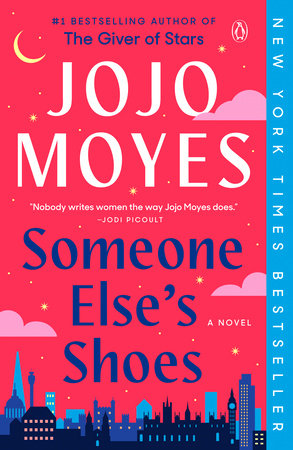
AN INTRODUCTION TO SOMEONE ELSE’S SHOES Jojo Moyes returns to contemporary fiction with witty, joyful, and lighthearted flair in
Someone Else’s Shoes. The novel grew out of a short story called “Crocodile Shoes” from Moyes’s book
Paris for One and Other Stories. Both the short story and the novel ask:
What changes when you must learn to walk in someone else’s shoes—literally? Nisha is the long-standing wife of wealthy American businessman Carl, a master of the universe of the first order. Living in a luxury London hotel as part of their privileged, globe-trotting life, Nisha is caught entirely off guard when—at the gym of all places—she learns Carl plans to divorce her. Nisha is glamorous, fearless, and determined to hang on to the life she has created for herself. But soon, Nisha must scramble to adjust to an entirely new landscape, living off charity, hotel biscuits, and fury as she tries to work out how to get back at Carl—and the woman who is now ensconced with him in the penthouse of the Bentley Hotel, literally wearing Nisha’s own clothes.
Sam is exhausted, at the bleakest point of middle age. Her husband is jobless and depressed, her best friend is fighting cancer, her daughter barely gives her the time of day, and her boss is systematically destroying the small pleasures she once gained from her job. She is a woman who has forgotten herself, invisible to seemingly everyone and trapped by everyone else’s needs. When she mistakenly grabs the wrong gym bag and becomes the new owner of Nisha’s Chanel jacket and red-soled Louboutins, she tries them on and relishes feeling like a different type of woman entirely.
When the two women finally meet, they will discover that each needs the other to put right the wrongs that have been done to them—and to the women around them. With all the charm, wit, and emotion that readers across the world have come to love from Jojo Moyes’s novels,
Someone Else’s Shoes is a story of mix-ups, mess-ups, and making the most of second chances.
A CONVERSATION WITH JOJO MOYES Someone Else’s Shoes is your first contemporary novel since the Me Before You trilogy. How did it feel to return to this genre after The Giver of Stars? It felt like the right thing to do. Like many people, I’ve had a tough couple of years, and I found myself being drawn to books, movies, and television that were lighter and that took me out of myself for an hour or two, and maybe left me feeling a little better for it. I wanted to create something that would make readers feel the same way.
The Giver of Stars came out of every part of me—it felt almost like a birth—and I wanted to go lighter and have a bit of fun at the same time.
While there are romantic subplots in Someone Else’s Shoes, the major focus is on the relationships among the women: Sam, Nisha, Jasmine, and Andrea. Why did you want to make the female friendships the driving force of the novel? I guess the older I get, the more I value the friendship and camaraderie of women. And I really am struck by the way that, once you hit your forties and fifties, women bond almost immediately, rather than competing against each other. I think there’s a universal recognition that everyone’s been through the mill in one way or another, and therefore a kind of humanity and empathy in how we deal with each other.
I wanted to take four very different women and show that kind of dynamic.
Nisha’s journey from penthouse wife to hotel maid almost has elements of screwball comedy. Your humor is one of the aspects of your books that your readers always love. How did you balance the comedic tone here with the real pathos of her situation? I don’t think you have to struggle to find the pathos of her situation—and that of many middle-aged women!—so it was really important to bring in humor with it. One of my favorite films is
Desperately Seeking Susan, in which two very different women who don’t know each other find their lives linked by a jacket. I wanted to mirror that fun, screwball element, but this time with older women trying to navigate their way in what is essentially still a very patriarchal world.
Someone Else’s Shoes highlights many of the struggles women experience in middle age. Why was it meaningful to put middle‑aged women front and center with this book? Probably because I am one! Seriously, middle-aged women have long been pretty invisible in entertainment, and I wanted to show them solving problems, taking care of each other, managing families, and having romantic entanglements, just like the ones I see in real life. But there are definitely difficult common themes that come with this age—marital crises, being squeezed by the generations on either side of you, being bypassed at work, or, in Nisha’s case, being traded in for a younger model, which are all very fertile ground for fiction.
You’ve recently entered a new chapter in your life—moving from a country home to the hustle and bustle of London. Did this in any way inspire the city life you so vividly describe in Someone’s Else’s Shoes? I think it’s no coincidence that I write about two middle-aged women who end up where they did not expect to be. In the three years I was writing this, I went through the end of my twenty-two-year marriage, two of my children left home, and I lost my mother. Pretty much every part of my life turned upside down—and that’s not counting a global pandemic. I realized that although I have loved living in the middle of nowhere, what matters most to me at this time of my life is being close to the people I love. So I decided to uproot and am now living near my oldest friend and my daughter. When I walk the dogs now, it’s on Hampstead Heath in London where I see a million people every day. It’s all a little scary, but my friends keep telling me change is growth, and I tell myself that if I decide I really don’t like it, I can move back again. The one thing this last few years has shown me is that nothing is ever set in stone . . .
From the first page, you do such an excellent job painting two very different pictures of two very different women: Nisha wears Chanel and Louboutin pumps, is a member of a luxury gym, and frequents some of the ritziest neighborhoods of London, while Sam is described as dressing more sensibly in understated work attire as she navigates her job as an accounts manager for a print solutions company. The different socioeconomic realities of both women are immediately apparent—and feel very topical now as economic disparity, wage gaps, and class differences become more pronounced in our culture at large. Can you discuss this and what you hope the effect is on readers? If there is a topic I find myself returning to again and again, it’s economic disparity. It was shot through
Me Before You and
The Giver of Stars, as well as
One Plus One. I’m always amazed it doesn’t feature more in fiction as most people I know are preoccupied by money and opportunity and how to get by. Also, I spent a lot of the last ten years traveling and living in hotels, and it is impossible—unless you are deliberately blind to it—not to notice the workers behind the curtain who keep that world running. My own family was far from wealthy when I was growing up; my mother used to make my clothes and my father’s family was very much working class. My first job was as a cleaner and my second was as a barmaid. So, I suppose I feel like I’ve seen both sides and can see the advantages and disadvantages of both and the tensions between them never stops fascinating me.
There are so many wonderful characters in Someone Else’s Shoes. Is there one you had the most fun writing? It’s got to be Nisha. I realized halfway through writing that I was actually describing in Nisha and Sam two polarized versions of the middle-aged woman. Sam is so squeezed by all the demands and requirements placed on her, but she internalizes it, and gets smaller and smaller, whereas Nisha is someone who genuinely doesn’t care what people think—she turns it all outwards, furious and vengeful. I think both of those women probably exist in me, but I’d love to be as fearless as Nisha. For example, when she is followed by the young men in the bar, I knew I didn’t want her to be frightened, and that she would get the upper hand over them. Despite her circumstances, she never sees herself as a victim. Even when she was behaving terribly, I couldn’t help but love her.
An adaptation of Someone Else’s Shoes is in the works, as a multipart drama. Who would be in your dream cast? You know, that’s where I think we may be blessed. Actresses in their forties comment so often on how hard it is to find interesting parts at their age—I feel like this story has four or five really rounded parts for older women, so I’m hoping that there is a raft of actresses I admire who might be interested!
QUESTIONS AND TOPICS FOR DISCUSSION 1. Sam and Nisha are very different women—Nisha lives a life of luxury and privilege; Sam is struggling to make ends meet and always has. And yet both of them share the quality of grit, of determination, that sees each of them through hard times. In Nisha’s case, she is also fueled by anger. Do you think that’s true of Sam as well—and is that common among the women you know?
2. Were you surprised when you learned Nisha’s own history and how she became the wife of an extremely wealthy man?
3. Sam’s work situation is, sadly, still all too common for working women. Have you ever been in a work situation where you felt unfairly judged, especially for being a woman, and, if so, how did you manage it?
4. What did you think about Sam and Phil’s marriage? Did you think she should have let herself pursue a possible love affair with Joel, or did you feel she and Phil were going to rekindle the spark of their relationship?
5. This book is about nothing if not about female friendship. What did you like best about the relationships among the women? Who was the character you liked best, and which one did you relate to the most?
6. When asked about her inspiration for this book, Jojo Moyes said, “Like many people, I’ve had a tough couple of years, and I found myself being drawn to books, movies, and television that were lighter and that took me out of myself for an hour or two, and maybe left me feeling a little better for it.” Have you had a similar experience with the entertainment you seek out? Did this book provide it?
7. Sam feels that she has lost herself among the demands of her family. It’s not until she starts to box, learns to trust her own skills at work, and develops a solid group of friends that she truly feels confident. Do you ever feel lost among the responsibilities that weigh on you? What do you do to feel like yourself again?
8. After successfully negotiating her first deal while wearing the red crocodile shoes, Sam worries that she’s “letting down the sisterhood” by using the sexiness of her new appearance to her advantage at work. What do you think? Is it OK to use appearance-based tactics when it comes to business?
9. Have you ever worn an outfit or an item of clothing that made you feel powerful? What was it? What changed for you?
10. Is Nisha a good mother to Ray? By the end of the book, did he receive the kind of support he needed? Why do you think Juliana was willing to come back into Nisha’s life to help Ray?