

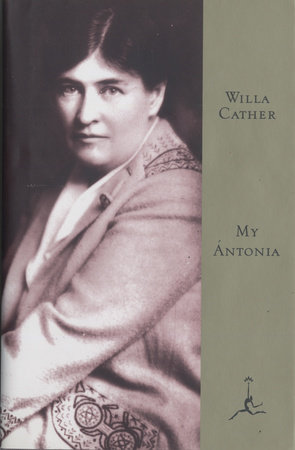

‘The best thing I’ve done is My Antonia,’ recalled Willa Cather. ‘I feel I’ve made a contribution to American letters with that book.’ Set against the vast Nebraska prairie, Cather’s elegiac novel features one of the most winning heroines in American fiction—Antonia Shimerda—a young woman whose strength and passion epitomize the triumphant vitality of this country’s pioneers.
‘If, as is often said, every novelist is born to write one thing, then the one thing that Willa Cather was born to write was first fully realized in My Antonia,’ observed Pulitzer Prize-winning author Wallace Stegner. ‘The prose is. . .flexible, evocative; the structure at once free and intricately articulated; the characters stretch into symbolic suggestiveness as naturally as trees cast shadows in the long light of a prairie evening; the theme is the fully exposed, complexly understood theme of the American orphan or exile, struggling to find a place between an Old World left behind and a New World not yet created. . . . No writer ever posed that essential aspect of the American experience more warmly, with more nostalgic lyricism, or with a surer understanding of what it means.’
Author
Willa Cather
WILLA CATHER was born in Virginia in 1873, and was about nine years old when her family moved to Red Cloud, Nebraska. After graduating from the University of Nebraska, she worked for a Lincoln, Nebraska, newspaper, then moved to Pittsburgh and finally to New York City. There she joined McClure’s magazine. After meeting the author Sarah Orne Jewett, she decided to quit journalism and devote herself full time to fiction. Her first novel, Alexander’s Bridge, appeared in 1912, but her place in American literature was established with her first Nebraska novel, O Pioneers!, published in 1913, followed by her most famous pioneer novel, My Antonia, in 1918. In 1922 she won the Pulitzer Prize for One of Ours. Her other novels include Death Comes for the Archbishop, Shadows on the Rock, The Song of the Lark, The Professor’ s House, My Mortal Enemy, and Lucy Gayheart. She died in 1947.
Learn More about Willa Cather
