READERS GUIDE
Introduction
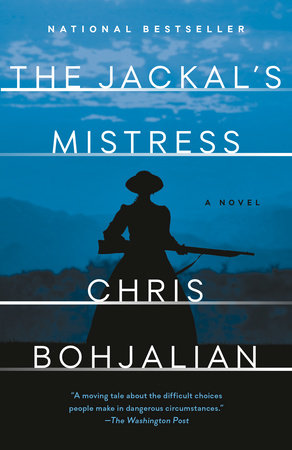
Would you risk your life to save a stranger? This is the question faced by Libby Steadman in the last year of the Civil War. Her husband, a Confederate army captain, is likely dead. He was captured at Gettysburg, and she hasn’t heard word of him in months. But the tables are turned when she discovers a severely wounded Union soldier in a house near her gristmill in Virginia’s Shenandoah Valley. He, too, is a captain, with a wife desperate to see him come home alive. Should Libby jeopardize the fate of her tiny household—Joseph and his wife, Sally, who are freedmen (if only on paper), and her firecracker niece, Jubilee? In an act of treason, the four of them give shelter to the desperate Yankee, hiding him from the Confederate army and the rebel guerrillas who despise his cause. As their visitor’s body heals, day by day, the threat of aiding him escalates to a shocking crescendo.
Inspired by a true, little-known event in history, The Jackal’s Mistress delivers heart-stopping suspense and a heartfelt tribute to the best of humanity. We hope this guide will enhance your book club’s experience of this twenty-fifth book from Chris Bohjalian, one of America’s greatest storytellers.
Questions and Topics for Discussion
1. In the novel’s opening scene, Libby and Joseph survive in part because the intruder underestimates them. In the many daring encounters they experience together, how do they turn their vulnerable identities into an advantage? How do they disguise their strength?
2. Libby excels in the men’s world—from running the mill and defending her loved ones to negotiating with Union troops. As a newcomer and an interloper, what made her a good match for her husband, Peter?
3. How do Sally and Joseph endure the traumas of their past, and the constant threats they face throughout the novel? What sustains their devotion to each other?
4. How did literature prepare Weybridge for the horrors and contradictions he would witness as a soldier? How did he maintain stamina in both mind and body?
5. In chapter 14, Weybridge tries to help Jubilee understand the abolitionist cause, while in chapter 20, Joseph gives Weybridge a grim dose of reality about what life will be like after the war. What perpetuated the system that kept Joseph and Sally from being truly free?
6. Jubilee nicknames Weybridge “Jackal” because she is wary of the enemy’s cunning ways. How does their relationship reflect the precarious balance of trust that teeters in other aspects of the storyline, on land, where dominance and control kept changing hands?
7. In the novel and in the true story that inspired it, what do we discover about the human capacity for kindness and healing, and the ability to rise above the destructive roar of the crowd (even when the roar is stoked by power brokers who benefit from the discord)? Ultimately, what do you think Libby’s real motivation was in protecting Weybridge? Would you have been willing to take that risk? Was Dr. Norton willing to take the risk only because he was being self-serving?
8. Libby, Emily, and Jubilee all must endure months of not knowing the fates of their loved ones who are at war. In their situation, is hope a positive force or is it a liability?
9. What transformations does Libby undergo during the final showdown in chapter 23? What does the scene reveal about her essence and the essence of the community she married into?
10. Who are the Henry Morgans and John Mosbys of the modern world, waging brutality under the guise of civility?
11. As you read the epilogue, how did you react? What was erased in the aftermath of the Civil War? What persisted?
12. What surprising details did you learn about this chapter in history? What family stories of war and survival have been passed down to you? How do those lives and stories compare with the ones portrayed in the novel? In what ways can fiction sometimes reveal the truth more fully than nonfiction?
13. How does Chris Bohjalian’s storytelling—in The Jackal’s Mistress and in his other novels that you have read—bring to life the intersection of chance and choice in a unique way?
About this Author
Q&A with Chris Bohjalian
1. The Jackal’s Mistress is based on a little-known true story from the Civil War. Can you please tell us briefly about your inspiration? Back in 2003, I wrote a magazine story for Reader’s Digest called “Crossing the Line.” It was the true account of a gravely wounded Vermont lieutenant in the Civil War whose life was saved by a Confederate woman in Virginia. The story was harrowing and the research fascinating. But this was in a period in my writing career when it hadn’t yet crossed my mind to try writing historical fiction: I was still known for novels about “social issues” that tended to be set in present-day Vermont – books such as Midwives and The Buffalo Soldier. So, it never occurred to me there was a novel in this story I wrote as a journalist for a magazine.
Flash forward two decades, sixteen books, and five historical novels later (novels such as Hour of the Witch and The Sandcastle Girls). I was in Richmond, Virginia and I was reminded of that Yankee solider and the rebel woman who moved heaven and earth to keep him alive.
And I knew instantly that I wanted to write a novel about the pair. It wasn’t merely that it was a great story: it was that it was the sort of tale that the United States needed right now, a drama that might remind us of our better angels, while (one can hope) being rivetted by a tale of remarkable courage and grace.
Now, it’s important to stress that The Jackal’s Mistress is a novel. The article I wrote for Reader’s Digest was merely the kernel for a much larger story I wanted to explore.
2. The Jackal’s Mistress is your 25th book. How would you say that your writing or process has changed since you wrote your very first novel? New Yorker journalist A.J. Liebling usually gets credit for the boast, “I can write faster than anyone who can write better and I can write better than anyone who can write faster.” I’ve also seen the quote attributed to Jack London. I am neither Liebling nor London, but I’ve been writing a long time: I’ve published at least 3.5 million words, including 25 books, a quarter-century of a weekly newspaper columns, three plays, and countless magazine stories. Muscle memory alone allows me to write faster and better than I could thirty years ago. Recall Malcolm Gladwell and his ten-thousand hour idea.
Other differences?
I wrote my first novel long-hand, using yellow pads and fine point Bic pens. Now I use a computer, either a large desktop or a small laptop when I’m traveling. I still edit by hand, printing out fifty or sixty pages at a time and reading the hard copy with a fountain pen. I use fountain pens because they demand that I read and write more slowly, to really ponder the right synonym for (for instance) claret or burgundy.
But I still write in the morning, a practice that began with my first three novels, all of which I wrote between five and seven a.m., before going to work at ad agencies in Manhattan and then Burlington, Vermont. I also write every day I am not traveling, including Christmas and Easter, getting to my desk well before the rest of the family wakes up.
3. There are so many admirable and endearing characters in this book, but Jubilee is a particular standout. You have a gift for writing about younger characters who are coming of age. Where did you find inspiration for Jubilee?
Younger characters can enhance a narrative because they lack adult filters and can say anything. Anything! Or they can be very quiet and still, a reader’s eyes on the action. Either way, as adult readers, we tend to worry about them.
So, yes, I love having kids in my books – though it’s important not to make them mere furniture or so precocious they’re cloying.
Now, the rebel woman who tried to save the Yankee soldier had a young niece living with her, though we know little about her. (She wasn’t named Jubilee.)
I’m glad you like Jubilee: I do, too. She’s certainly a literary descendant of some of my other smart, tough-as-nails teens from my earlier books, characters such as Connie Danforth (Midwives), Emily Shepard (Close Your Eyes, Hold Hands), and Marisa Dowling (The Princess of Las Vegas).
4. No two books that you’ve written are alike, but you tend to return to historical fiction again and again. What is it about the genre that makes you love writing it so much? It is indeed a goal of mine to never write the same book twice.
Of my 25 books, about a quarter are historical fiction – and three of my last four have been set in 1662, 1964, and 1864, respectively.
In any case, I’m drawn to historical fiction as a reader, which is probably why I’m drawn to it as a writer.
But I also devour a lot of non-fiction both as research for my novels or as pure enjoyment.
The thing I enjoy about historical fiction is that it allows us to probe a different sort of truth than we can derive from actual fact. Thomas Moore, author of such books as Care of the Soul, taught me how we may not all define the soul the same way, but we all know on some level what the soul is. Likewise, we all understand that the soul knows what it wants and what it needs. Historical fiction is like that. Books such as Toni Morrison’s Beloved or Esther Forbes’s Johnny Tremain may not be the last word on the literal atrocities of slavery or the specifics of being an apprentice silversmith at the start of the Revolutionary War, but they offer profound insights into those worlds that move the soul. My novel about the Armenian Genocide, The Sandcastle Girls, has educated countless readers around the world to the forgotten horrors the Ottoman Empire inflicted upon its two million Armenian citizens beginning in 1915 (including my ancestors) – readers who never would have picked up any of the memoirs or histories of the Genocide.
That doesn’t mean that historical fiction can take license with history. I’m not a fan of altering history for a novel (or movie or TV series). But I love the way historical fiction can bring history to life in ways that transcend dates or speeches or battles.
5. What is the question that you are getting most frequently from readers about TJM, and how do you typically respond? Did you know how weirdly timely the novel would be when you were writing it?
Answer? Yes. I’m not prophetic, but we’ve been a fiercely divided nation for a while now.
6. If you could ask reading groups one question about The Jackal’s Mistress, what would it be? If you were Libby Steadman, the novel’s Virginia heroine, how far would you go to try and save the life of Jonathan Weybridge, the dying Vermont officer? After all, you’re risking your life, your niece’s life, and the lives of Joseph and Sally, the two adults closest to you since your husband was captured at Gettysburg and likely died in a Union prison camp?
Suggested Reading
Geraldine Brooks, Horse
Stephen L. Carter, The Impeachment of Abraham Lincoln
Percival Everett, James
Shelby Foote, Shiloh
Charles Frazier, Cold Mountain
Ariel Lawhon The Frozen River
James McBride, The Good Lord Bird
Michael Shaara, The Killer Angels
J. Courtney Sullivan, The Cliffs
Colson Whitehead, The Underground Railroad
Caroline Woods, The Mesmerist
Read More Historical Fiction by Chris Bohjalian Hour of the Witch
The Sandcastle Girls
The Light in the Ruins
The Lioness
Skeletons at the Feast