READERS GUIDE
In Conversation with Beth Morrey
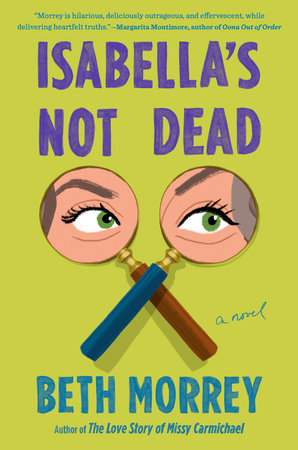
- Isabella’s Not Dead is your fourth novel. What inspired you to write this story? How was writing Isabella’s Not Dead similar to or different from writing your previous books?
The idea was sparked by the film The Banshees of Inisherin. It’s about a broken friendship; the jilted friend becoming obsessed with finding out what went wrong. I really loved the film, found it funny and moving, but it’s a very male story, and I wondered what a female version would look like. Then I realized I could draw on my own experiences of friendship-ghosting to offer a counterpoint. The writing flowed very quickly, weaving in semi-autobiographical detail, but also the fantasy of how a hunting-quest might turn out. Like my previous books, this is a story of a woman going on a journey of self-discovery at a crucial turning point in her life, and fingers crossed it offers a little hope, humor and heft to my readers. But it also has a dash of intrigue—it’s a sweeping love story about platonic friendship, and a murder mystery, about the death of that friendship. Employing some of the techniques of the mystery genre was challenging and fun! It’s also semi-epistolary, with a lot of the story told in the form of emails, postcards, and restaurant reviews. So it offers something a bit different to my previous books, while hopefully retaining familiar elements. - Are Gwen and Isabella based on real people? How did you come to craft their characters?
I’m sorry to say that Gwen is me. Or at least, she has a lot of my qualities, and “qualities” isn’t the right word—more like “flaws”! I lampooned myself ruthlessly. Initially Gwen’s sour, a bit antisocial and closed-off, though as the book progresses, she finds joy in life again and becomes less cynical. Isabella is based on various people I’ve known, friends I’ve loved and lost, and she was written as a kind of absent heroine, with Gwen as the antiheroine. The book is a love letter to Isabella, in essence. People talk about “the One that got away,” romantically, and Isabella is the platonic version. I took a few of the ingredients of a classic romance, and applied them to Gwen and Isabella’s relationship—their first meeting, their correspondence, their break-up . . . 3. Although there are many life lessons in
Isabella’s Not Dead, what is one you want readers to take away from their read?
A yearning for connection. We can’t maintain good friendships with everyone we meet, but we have to foster the relationships that matter, and that takes work. We need to commit to the people who count, be there for them, care, and listen. Listening is a big theme of the book—there are lots of instances of people mishearing, or ignoring, or forgetting things other people have told them. I wanted to highlight the importance of paying attention. It’s not so much a life lesson—I wouldn’t presume—but it would be cool if people read the book, thought of a good friend, and got in touch to say, “Hey, how are you?” 4. Did you have to do any research to write
Isabella’s Not Dead? If so, what did that look like?
The book features a deaf character, Min, who is one of Gwen’s old hockey teammates. I wanted to make sure I portrayed her sensitively, so I read up a lot on the subject to give color to her interactions with Gwen. I consulted a deaf authenticity reader, who gave me invaluable insights, advising me on sections of the text that he felt weren’t accurate or could be improved. I also learnt a bit of sign language so that I could describe gestures that Min and Gwen use when they’re talking to each other. Though it’s worth bearing in mind that this is British Sign Language, which might differ from the American version! 5. If you could cast Gwen Mortimer in a movie or TV series, who would play her? What about the other supporting characters? Are there any movies or TV shows that you think give the same energy as
Isabella’s Not Dead, and that you would recommend to readers?
The dream would be Tina Fey playing Gwen, because I worship her, and I’ve just watched her latest project, The Four Seasons. Her character Kate isn’t a million miles away from Gwen, and, in fact, the tone of The Four Seasons works for Isabella’s Not Dead. It’s a similar life stage, similar humor, and a bit of travel! It’s also a mix of light and shade, mostly funny but sometimes a little darker and edgier. Another film reference would be You Hurt My Feelings, starring Julia Louis-Dreyfus, which I loved. Julia also has Gwen-energy (Gwenergy?!), and I adored the quirkiness of it, basically making a mountain out of a molehill, but somehow making it matter. Gwen’s quest verges on ridiculous—reckless and self-indulgent—and yet I wanted the reader to be on board with it, to urge her on. Morag, Gwen’s mad mother-in-law, would be played by a national treasure with comedy chops—someone like Lily Tomlin, Catherine O’Hara, or Bette Midler. They could have a lot of fun with the character, who is a very strong flavor. 6. What was your favorite scene to write, and why?
I really enjoyed sending Gwen to Edinburgh, because it happens in the middle of the book, and I’m usually hitting my stride by that point. That section wrote itself; Gwen just went off and did her thing while I made notes. Some of the things she did surprised me! She gets epically drunk and in many ways the trip is a total failure, but in other ways she makes great strides in her investigation. Edinburgh is one of my favorite cities—I know it so well I didn’t need to research it, but went up there to refresh my memory all the same! It’s such a dramatic backdrop for Gwen to get up to no good . . . 7. Gwen no longer has a corporate career, but started a mosaic tiling business for minor profit. What inspired you to write this aspect of her life this way?
When I was about twenty I got dumped, and for some bizarre reason started mosaic tiling to soothe myself. I carried on the hobby intermittently, and tiled random bits of our house whenever I was at a loose end. I’m quite good at it, and it’s very focusing. Gwen is at a kind of “loose end” point in her life, where she’s lost her job and her kids are more independent. She’s gone from being super-busy to slightly aimless. I needed her to have an occupation that was unexpected, offbeat, and not at all lucrative, but it was also helpful thematically. She’s literally putting fragmented pieces back together to form a picture—and that’s what she’s doing with her Isabella investigation, too. 8. Without giving anything away, did you always know how the novel would end?
I always knew exactly how the story would end. I don’t plan very much when I write a novel—in fact, I make barely any notes in case it ruins the magic! But I do need the basic arc of the narrative in place, and that includes the ending. Not just what happens, but the tone and emotion of it—how do I want it to feel? And I knew I wanted a happy, empowering finish, but also a realistic one. I feel so embarrassed typing this—it’s so self-aggrandizing—but I cried when I wrote the last scene. It felt not just like I’d laid a ghost to rest, but that I’d had a little dance with it and cheerily waved it off. 9. Did you have a favorite character to write? If so, who were they, and why were they your favorite?
Morag, Gwen’s mother-in-law, and Mabel the dog. I always try to feature an animal and an eccentric older woman in my books, and I think these are two of the best examples. Morag is crazy, in an entertaining way, and Gwen goes on a journey with her, too, physically and emotionally. She comes to appreciate Morag’s useful qualities alongside the more dubious ones! And Mabel the Labrador is the third party in Gwen and Angus’s marriage—Mabel’s disdain for Gwen is strongly evident throughout the book, and I enjoyed portraying a dog who is so dismissive. 10. What is your favorite place that Gwen travels to in her search for Isabella?
There’s a big set piece featuring a European capital that was an ambitious destination—for Gwen and for me. I wanted to make Gwen’s quest as extensive and heedless as possible, so this trip was key in terms of showing how far she’s gone (in every sense). But on a more intimate level, there’s a moment when Gwen wanders into a big art gallery in Manchester and looks at a couple of significant paintings—a Lowry work called Piccadilly Gardens
, and Modigliani’s Portrait of an Unknown Model
. It’s a really pensive, profound juncture for her and I like the loaded quietude of that scene. You have to mix up the pace when you’re telling a story—it can’t all be full-on action, so I value some of the slower moments and low-key places. Light and shade, funny and serious, action and reflection—putting all of the varied fragments together to form the bigger picture. Discussion Questions
1.
Isabella’s Not Dead explores the death of a best friendship and the hunt to figure out what happened. Why do you think it’s important to highlight these types of stories or narratives? What was one lesson you learned from this novel?
2. As Gwen searches for answers, she’s joined by a wacky cast of characters, including her eccentric mother-in-law. Who, if any, of Gwen’s companions do you think you’d be friends with in real life?
3. Have you known anyone like Isabella in your life? Can you understand Gwen’s desperation to have Isabella in her life, and repair the rift? Why or why not?
4. What was your favorite scene in the novel, and why?
5. As the novel unfolds, you come to know Gwen and her feelings of inadequacy in comparing her life choices with Isabella’s. How do you think this has affected Gwen over the years and fed into her need to find out why Isabella disappeared from her life?
6. Have you ever been ghosted by a friend, or ghosted a friend yourself? If so, why do you think that happened, or why did you decide to end the friendship that way?
7. Who was your favorite character, and why?
8. What do you think changed for Gwen throughout the course of the novel?
9. How far would you go to find answers to a mystery like Gwen’s? Do you think she goes too far?
10. What were your thoughts on the ending?