





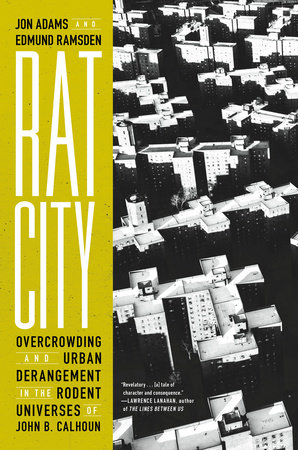
TEACHING GUIDE
DISCUSSION AND WRITING
Of all the available animals, why do Calhoun and so many of his contemporaries consider the rat such a good model for experimentation? In what ways are comparisons between rats and humans controversial?
Ecology is a relatively new field when Calhoun begins his research, but very soon, the term “ecology” starts appearing in the social sciences, health research, and even computer programming. What is “ecological” thinking, and why does it become so popular?
What is meant by “overpopulation,” and why did it seem so important in the 1960s? Why were concerns about overpopulation so controversial? Do you think overpopulation remains a problem?
Calhoun encounters many different “model” environments—Sherman’s swift tower, beetles in a test tube, mites on an orange, and of course Calhoun’s own rat cities. What are the advantages, and the drawbacks, of studying an organism in an artificial habitat?
Calhoun remembers that the metal crates used by his fellow animal researchers in the 1950s make him “squeamish.” How does Calhoun’s approach to animal research differ from his contemporaries, and—considering the conditions his rodents endure—is his version of animal research any more ethical?
In what ways were studies of crowding useful to public policy? What are some of the benefits and limitations of using density as a measure of health and welfare in public policy, e.g. housing reform, slum clearance, institutions?
Having argued both that the crowding in cities is harmful and also that the bustle of city centers can be positive, Calhoun’s group of Space Cadets settle on “privacy” as a crucial requirement for mental wellbeing and social harmony. How does “privacy” differ from “isolation”?
Why did social and behavioral studies of urban environments fall out of favor in the National Institute of Mental Health in the 1970s?
Calhoun’s later work involved designing systems for global communication: why did he think that communication networks were so important? What did Calhoun mean by a “Global Alerting System,” does such a system exist today?
Between the few dominant rats and the masses of low-ranking submissive rodents, Calhoun identified a class of “creative deviants.” What did he mean by “creative deviant” and why did he think they were valuable?









×