
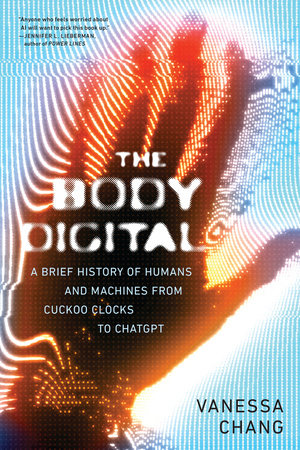
The Body Digital Reader’s Guide
By Vanessa Chang



The Body as Interface
Think of a technology you use daily—your phone, keyboard, bicycle, eyeglasses. How has it changed how your body moves, how you think, or how you communicate with others? The book suggests that technologies are not separate from us, but emerge through and alongside our bodies. What does your example suggest about this relationship?
The computer scientist Mark Weiser said “a good tool is an invisible tool”—one that becomes second nature through use. Can you think of technologies that have become invisible to you through habit or familiarity? Who benefits when technology fades from our conscious awareness? What might we lose?
Anxiety, Automation, and Creativity
In 1906, composer John Philip Sousa feared player pianos and phonographs would destroy music. They didn’t kill music, but they did change it—from participatory practice to passive consumption, while also democratizing access. What does this example suggest about contemporary anxieties around AI and creative work?
The Jacquard loom automated weavers’ skilled hands by encoding their knowledge into punch cards. How does this nineteenth-century invention help us see what’s happening with AI today? When embodied skill—knowledge held in hands, eyes, muscle memory—becomes code, what changes?
What’s the difference between technologies that “extract” human skill versus those that “extend” human capacity? Can you identify examples of each from your own experience? Is this difference built into the technology itself, or does it depend on how it’s designed and used?
Socrates worried that writing would weaken human memory—that outsourcing thought to external symbols would atrophy our cognitive abilities. What parallels do you see with contemporary concerns about AI? What’s similar and what’s different about these technological transformations?
Connection, Care, and Design
The mixtape was a “love language” requiring time to curate and record. How is this different from sharing a Spotify playlist? What changes when sound becomes infinitely reproducible and instantly shareable? What does this tell us about technology and relationships?
The “curb cut effect” describes how designing for wheelchair users (curb cuts) ended up benefiting many others—parents with strollers, delivery workers, cyclists. What does this teach us about technology design? Can you think of other examples from everyday technologies—smartphone features, voice commands, or automated captions?
Smart cities use sensors to track how people move through urban space, promising optimization and efficiency. What movements in your daily life generate data? Who benefits from that data, and who might be left out or exposed?
Resistance, Imagination, and Ecology
The book suggests that our bodies “remember, resist, reimagine, reconfigure.” What does it mean for a body to “resist” or “reimagine” technology? Can you think of times when people have adapted tools for new purposes or used technology to create connection in ways designers never intended?
The book advocates for an “ecological” approach to technology, one that treats humans, tools, and environments as interconnected parts of a living system. What would change if we designed technology this way? How might a smartphone, a city, or an AI system be different if built with this perspective?