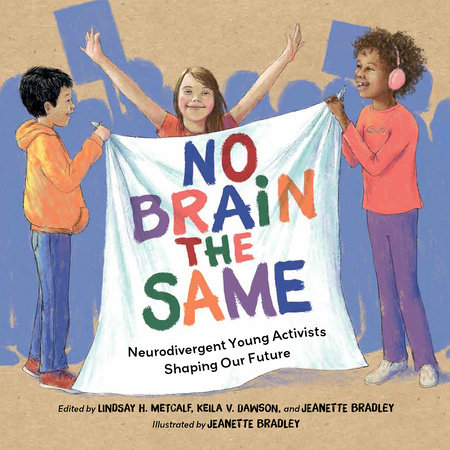
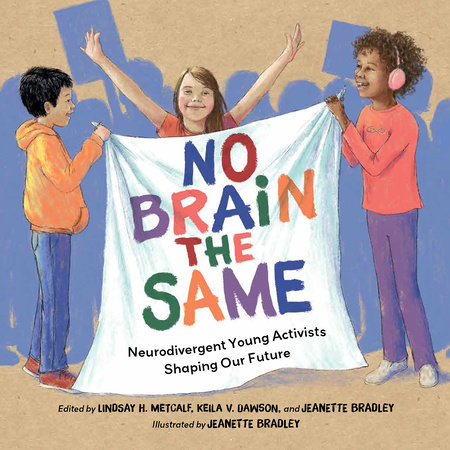
♦ Structured as a poetry anthology, this collection thoughtfully curates a range of forms, including free verse, sonnet, concrete, nonet, and kenning, in ways that intentionally reflect the central premise of neurodiversity. A glossary of poetry types teaches this variety. The opening kenning poem, “We Are the Future,” layers identity through metaphor, naming young people as “open dreamers” and “justice leaders,” and establishing a steady cadence of affirmation that reverberates across the text. The diction is precise yet accessible, balancing lyrical intensity with clarity so that readers can both feel and cognitively process the activists’ lived experiences. Form and content work in tandem, mirroring the complexity, variability, and strength of the individuals featured. Bradley’s digitally rendered illustrations, with their textured paper effects and warm earth tones punctuated by intentional bursts of color, extend the poems rather than merely accompany them. For example, in Connor DeWolfe’s spread, the sense of movement and expressive detail visually reinforces the poem’s pacing and emotional charge. Across the anthology, text and image collaborate to position neurodivergence as brilliance, agency, and creative force. VERDICT A rhetorically intentional and visually cohesive anthology that models inclusion not only in message but also in craft.
—School Library Journal, starred review
Poets introduce 14 neurodivergent trailblazers.
Using poetic forms as diverse as their subjects, authors sharing aspects of these young people’s identities celebrate their bravery and creativity. Some figures will likely be familiar, such as singer Billie Eilish, “a girl with Tourette’s” who “turned tics into chords”; others may be new to readers, like Liam Garner, an autistic youth who biked from Alaska to Argentina. A brief biography and a motivational tip (“Use your unique perspective to solve problems”) follow each poem. Bradley’s photorealistic illustrations convey subjects’ joy and determination. Some lines feel cliched, as when Vanessa Brantley-Newton’s double couplet series “Her Name Means Light” proclaims Helena Donato-Sapp—an anti-bullying advocate with ADHD, visual processing and memory disorders, and dyscalculia—“young yet wise beyond her years.” Others are thought provoking; Sally J. Pla’s free-verse intro to Dara McAnulty, who is autistic and who wrote the award-winning A Young Naturalist’s Diary, concludes that “saving Nature / is the only way / we can save / ourselves.” Hannah Emerson’s “Dear Adam” echoes the cadence of nonspeaking autistic poet Adam Wolfond (who communicates with a text-to-speech app): “floating reality / becoming dear great treeing / named Adam yes yes.” A list of affirmations matched to each subject (“You are not broken. Helena refuses shame for her identities”) summarizes the encouraging collection. Backmatter includes author information and defines terms, poetic forms, and conditions portrayed here, which include Down syndrome, anxiety, and stuttering.
Eclectic and empowering.
—Kirkus Reviews





 QUICK VIEW