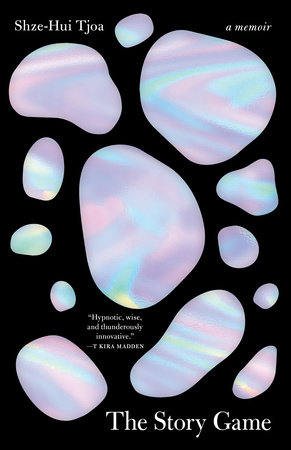
Probes the author’s mixed feelings about her father’s homeland in Bali, her life in London, the dynamics of her marriage to a white German man and more.—New York Times Book Review
An intimate exploration of a woman’s identity. . . . Memory, loss, trauma, and powerlessness emerge as salient themes in this probing memoir.—Kirkus Reviews
Interrogates subjects including racism and colonialism with piercing intellect. . . . Gorgeous prose and lucid political thought.—Publishers Weekly
Imaginative.—Book Riot, A Best Book of May
A profound, clear-eyed, and harrowing explanation of what it takes to confront and heal from traumatic memories.—Brooklyn Rail
For fans of Stephanie Foo’s What My Bones Know and Jami Nakamura Lin’s The Night Parade, The Story Game is a must-read… it offers the reader a chance to heal alongside the author.
—Adroit Journal
Wonderfully insightful…. Beautifully written.—Cha Journal
The Story Game introduces a major debut work from a most astounding talent. Shze-Hui Tjoa’s memoir not only challenges genre, it upends and splits it wide open. In meditations on grief, displacement, mental health, and family, Tjoa will have you wondering how and why we remember, and what we can’t forget. The Story Game is hypnotic, wise, and thunderously innovative. I will teach this book, I will treasure it, and I will continue to learn from its astute and hopeful insights.
—T Kira Madden, author of Long Live the Tribe of Fatherless Girls
Shze-Hui Tjoa’s The Story Game is a patient excavation of selves: not the I of today, but the version before and the one before that, flawed and flawing, all the way back to childhood, reaching through history and memory to dust free so many cruel reflections. Ardently exquisite, Shze-Hui Tjoa tenders astonishment with blushing tenacity.
—Lily Hoàng, author of A Bestiary
Reading this, I forgot about the real room I was in. I felt fully contained in the invented room separating The Story Game’s chapters. In The Room, Shze-Hui Tjoa makes make-believe serious the way children do—but she does it by playing with the memoir genre. As her storytelling progresses, she plunges, as the greatest writers have, to The Depths, revealing how the artistic process transforms her understanding of mind and body. Her ascent into The World is startling and powerful. After I read it, I felt a new world of creative possibilities opening. The Story Game is hyper-specific yet ethereal, serious and funny. It’s mesmerizing.
—Jeannie Vanasco, author of Things We Didn’t Talk About When I Was a Girl
Shze-Hui Tjoa’s memoir is unlike anything else I’ve read. The Story Game shows us the place where forgotten truths can finally be shared. It’s an astonishing work of imagination, emotion, and memory. I’ll be reading this one again.
—Wendy S. Walters, author of Multiply/Divide: On the American Real and Surreal
Both formally innovative and page-turning, Shze-Hui Tjoa transports us in The Story Game back and forth between two sisters in their childhood bedroom and the outside world. We eventually find ourselves siding with Nin’s interruptions and questions: Where is Hui? Who is Hui? Tjoa’s gaze upon the world is both tender and wry, and for those of us who are women or queer or people of color and have dreamed of a life lived solely in the mind, Tjoa shows us slowly, little by little, layer by layer, how disembodiment often comes at a great cost. With each attempt at truth-telling, we come to see just how easily we can omit what is essential to understanding ourselves and, thus, those most important to us.
—Alysia Li Ying Sawchyn, author of A Fish Growing Lungs





 QUICK VIEW